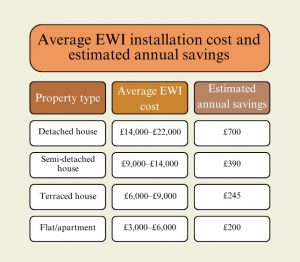
If you’re searching for external wall insulation grants in the UK in 2025, this guide will walk you through everything you need to know. Insulation grants can provide significant support for homeowners seeking to reduce rising energy bills, enhance comfort, and meet climate targets. With the right grant and installations, you could transform your home’s efficiency and value for a fraction of the usual cost.
In this guide, we’ll explain how external wall insulation works, which grants are available, who’s eligible in 2025, how much you could receive, and how to get started, whatever your property type or situation.
How external wall insulation works
External wall insulation involves fixing a thick layer of insulating material, such as EPS or mineral wool, to your home’s exterior walls, then covering it with weather-resistant render or cladding. This creates a protective thermal barrier that reduces heat loss, keeps your home warmer in winter and cooler in summer, whilst also safeguarding the wall structure underneath. It can be especially useful for older homes with solid walls.
Benefits for energy efficiency and comfort
By reducing heat loss through external walls by up to 35%, this insulation leads to a warmer, less draughty home and cleaner air, making it more comfortable to live in, better for health, and more affordable to run in both winter and summer.
Difference between internal and external wall insulation
Internal insulation is fitted inside a property, which reduces the room size and might mean moving radiators or sockets. External wall insulation keeps rooms fully intact, freshens your home’s exterior, and protects it from weather damage. The upfront cost is higher, but so are the long-term savings, and the disruption during installation is mostly outside.
What are external wall insulation grants?
External wall insulation grants are funding provided by the government, energy suppliers, or councils to cover part of, or sometimes the entire, cost of external insulation. The aim is to make energy-saving improvements accessible to more homes and tackle the UK’s urgent need for warmer, greener housing stock.
How external wall insulation grants help homeowners
External wall insulation grants mean homeowners could pay nothing, or at least a lot less, for major home upgrades that would otherwise cost from £10,000 to £20,000. Without grants, many people would put off or be unable to afford essential insulation. They therefore help ordinary people to improve the comfort of their home and lower their energy bills, whilst also saving energy and reducing emissions.
Who provides external wall insulation grants – government, councils, energy suppliers
External wall insulation grants may be provided by the government, local councils, or major energy suppliers. The majority fall under two government-backed umbrellas:
- Energy Company Obligation (ECO4): A government scheme that requires medium and large energy suppliers to fund eligible upgrades for low-income homes.
- Great British Insulation Scheme (GBIS): A central government programme run in partnership with local councils and Ofgem, available to an additional 400,000 households.
- Warm Homes: Local Grant: Available through local councils in England (with similar schemes available in Scotland, Wales, and Northern Ireland), it provides energy-saving improvements to certain homes.
Local authorities also have other grants you may be eligible for, especially if you live in certain high-priority regions or meet additional needs. Some of these grants can reach up to £30,000 and may be used to help pay for a variety of home improvements to increase warmth and energy efficiency. This includes insulation, double glazing, solar panels, and heat pumps.
Why these grants exist
Insulating Britain’s homes is a core pillar of the UK’s Net Zero 2050 agenda. Heating and powering our buildings accounts for around a fifth of national carbon emissions. Government grants aim to upgrade thousands of older, hard-to-heat properties and lift millions out of energy poverty.
External wall insulation grant schemes available in 2025
Here are the major grant schemes active and launching in 2025:
Great British Insulation Scheme (GBIS)
The GBIS is the UK’s flagship government grant for insulation. This £1 billion government initiative is available for households in England, Scotland and Wales to improve their homes’ energy efficiency through insulation upgrades. Administered by Ofgem, the scheme targets the least energy-efficient properties to tackle fuel poverty and reduce carbon emissions. It runs until March 2026.
Unlike the ECO4 scheme’s comprehensive approach, GBIS typically provides one insulation measure per property (though from May 2025, some households may receive two measures under certain conditions). Energy suppliers are obligated to deliver these improvements, and you can approach any participating supplier regardless of who provides your energy.
Who qualifies for the scheme?
The scheme covers two main groups:
1. Low-income group: You’ll need to receive at least one of these benefits:
- Child Benefit.
- Pension Guarantee Credit or Pension Credit Savings Credit.
- Income-related Employment and Support Allowance.
- Income-based Jobseeker’s Allowance.
- Income Support.
- Universal Credit.
- Housing Benefit.
2. General group: Your property must have an EPC rating between D and G, and fall within council tax bands A to D in England, or A to E in Scotland and Wales.
3. Local authority flexible eligibility: Your local authority or energy supplier can also refer you if you have a combined household income under £31,000, or if someone in your home has a severe or long-term health condition (such as cardiovascular problems, respiratory disease, limited mobility or immunosuppression) worsened by cold conditions. Suppliers can also refer households struggling with persistent fuel debt or using prepayment meters who regularly lose supply due to financial hardship.
What’s covered?
Available insulation types include:
- Cavity wall (including party walls).
- Loft insulation.
- Solid wall.
- Pitched roof and flat roof.
- Underfloor and solid floor.
- Park home insulation.
- Room-in-roof.
If you’re in the low-income group and own your home, you may also receive heating controls like room thermostats as a secondary measure.
Costs and funding
Funding levels vary depending on the measure type and energy supplier. Lower-cost measures like cavity wall or loft insulation may be fully funded, whilst higher-cost options such as solid wall insulation often require a household contribution. The scheme isn’t a grant programme, so different companies offer varying support levels. We’d recommend getting quotes from multiple installers to find the best deal.
You cannot combine GBIS funding with other government schemes like the Home Upgrade Grant, Boiler Upgrade Scheme, ECO4 or Social Housing Decarbonisation Fund.
How to apply
You’ll need to own your property or have your landlord’s permission (including social housing providers). Contact any participating energy supplier to discuss eligibility. They’ll arrange a retrofit assessment to determine which insulation measure suits your property best.
All installers must be TrustMark-accredited, so always check their credentials before agreeing to any work. Getting multiple quotes is advisable to ensure good value.
Remember that meeting eligibility criteria doesn’t guarantee installation, as suppliers decide which projects to fund based on various factors. Find out which grants might be available to you with our Grant Calculator.
Energy Company Obligation 4
ECO4 is a long-standing obligation on major energy providers to improve the EPC of the UK’s least efficient homes.
- Targets low-income and vulnerable households, plus properties with poor EPCs (D–G).
- Funding is often best for homes with very low EPCs (E–G), but partial grants are available for D band.
- Early 2025 guidance shows ECO4 will run until at least Spring 2026.
ECO4 is a government energy efficiency scheme running from April 2022 to March 2026, worth £4 billion. It’s designed to tackle fuel poverty, reduce carbon emissions and help vulnerable households heat their homes more affordably. The scheme places legal obligations on medium and large energy suppliers to fund energy-saving improvements in eligible properties across England, Scotland and Wales.
Who qualifies?
You must live in private housing (owner-occupied or privately rented) or social housing. For private housing, you’ll need to claim at least one of these benefits:
- Universal Credit.
- Pension Guarantee Credit or Pension Savings Credit.
- Income Support.
- Income-based Jobseeker’s Allowance.
- Income-related Employment and Support Allowance.
- Child Benefit.
- Housing Benefit.
Additionally:
- Owner-occupied homes must have an EPC rating of D, E, F or G.
- Private rental properties must have an EPC rating of E, F or G (and you’ll need your landlord’s permission).
- Social housing must have an EPC rating of E, F or G.
Local authority flexible eligibility: Your local authority or energy supplier can refer you if you’re experiencing financial hardship, persistent fuel debt, or regularly can’t afford to top up prepayment meters. Those in the Warm Home Discount ‘core group’ are also likely to be eligible.
What’s covered?
Unlike GBIS, which typically delivers single measures, ECO4 takes a comprehensive ‘whole house’ approach. This means multiple improvements can be made to bring your home up to at least an EPC rating of C where feasible.
Available measures include:
- Insulation (loft, cavity wall, solid wall, underfloor, pitched and flat roof, room-in-roof).
- Heating system upgrades or replacements, including boilers.
- First-time central heating installation.
- Storage heaters.
- Heat pumps.
- Solar panels (in certain circumstances, such as when paired with heat pumps or electric heating systems).
- Heating controls.
Costs
The scheme isn’t technically a grant programme. Energy suppliers decide which projects to fund and the level of support provided. Whilst many improvements may be fully funded, you might be asked to contribute towards costs, particularly for higher-value measures like solid wall insulation or heat pumps. We’d recommend contacting multiple suppliers to compare what’s on offer.
How it works
Energy suppliers must meet targets based on their market share. They work with installers registered with TrustMark (the government-endorsed quality scheme) to deliver improvements that comply with PAS 2035/2030 installation standards. Ofgem administers the scheme, tracking supplier performance and ensuring compliance.
Applying
Contact your local council to see if they’re participating, or approach energy suppliers directly. You don’t need to be a customer of the supplier you approach. Check Ofgem’s website for a list of obligated suppliers.
All installers must be TrustMark-accredited, so always verify credentials before agreeing to work.
The UK Warm Homes: Local Grant Scheme
If you’re on a low income in England and your home’s energy performance is poor, you might qualify for grants to make energy-saving improvements like insulation, draught-proofing, double glazing, solar panels and heat pumps.
The scheme started in April 2025 and runs until March 2028. Similar programmes exist across Wales, Scotland and Northern Ireland, and you may be able to combine this with other schemes like the Great British Insulation Scheme.
To apply, you’ll need to meet all these criteria:
- Live in England.
- Own your home or rent privately.
- Have an EPC rating between D and G.
Plus, you must have a household income under £36,000, live in an eligible postcode, or receive means-tested benefits (like Universal Credit, Pension Credit or Housing Benefit).
You could receive up to £15,000 for energy-efficiency upgrades, plus another £15,000 towards low-carbon heating like heat pumps. The goal is to bring your home up to at least a ‘C’ rating. Improvements include:
- Low-carbon heating (air and ground source heat pumps, sometimes high retention storage heaters).
- Energy-saving measures (insulation, solar panels, battery storage).
Who qualifies for an external wall insulation grant?
Grants in 2025 have widened the net but still focus support on those who need it most.
Eligibility by income or benefits
Most schemes target households earning under £31,000 a year, or those receiving benefits such as Universal Credit, Pension Credit, or Housing Benefit. For the self-employed, profit (not turnover) is taken into account for fairness. To find out if you are eligible, try our Grant Calculator.
EPC rating
You usually need a property rated EPC D, E, F, or G to qualify. Higher (A–C) are rarely eligible. Priority is given to properties in the E–G risk group. If you don’t have an EPC, a surveyor will arrange one as part of your application.
Property type: solid-walled, detached, semi-detached, flats
Most grants are for owner-occupied or private rentals with uninsulated solid walls. Flats may qualify, but often require block-level applications and landlord/leaseholder permission. Council or housing association tenants should check with their landlord or local authority about funded pilot schemes.
Tenants vs homeowners: who can apply?
- Homeowners: Apply directly for most grants.
- Private tenants: May apply with written landlord consent; landlord’s cooperation is essential.
- Landlords: Typically cannot apply alone unless arranging block-level upgrades, but must consent for tenant participation.
Documents you’ll need
- EPC (Energy Performance Certificate), or booking for one.
- Proof of income or benefit entitlement.
- Council tax band.
- ID and ownership verification (title deeds, mortgage, or tenancy agreement).
How to apply for an external wall insulation grant
Step-by-step application process
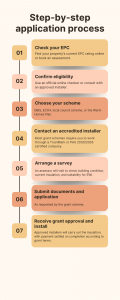
Common mistakes to avoid
- Using non-approved installers (makes you ineligible for funding).
- Missing deadlines or incomplete paperwork.
- Not securing landlord or freeholder consent (for flats, blocks, or rentals).
- Expecting grant funding for non-qualifying (A-C EPC or higher income) properties.
How much can you get?
Full vs partial grants
- Full grants: For low-income or fuel-poor households, the grant might cover the entire installation cost, sometimes worth up to £15,000, especially if combined with heat pump or renewable upgrades.
- Partial grants: For households in the “general group” or higher council tax bands, the grants may cover 30–80% of the total cost, leaving a balance for you to pay.
Example costs and savings
- A standard three-bed semi-detached home costs around £10,000–£20,000 to insulate; a full GBIS/ECO4 grant could reduce this to nil for those eligible, and partial grants may leave you paying only a few thousand pounds.
- Annual savings on heating are generally £300–£700 for a solid-walled house, meaning that even partial grants pay back quickly, thanks to lower energy bills.
Approved installers and accreditation
It is critical that you use approved installers with accreditation for any upgrades if you want to qualify for external wall insulation grants.
Why accreditation matters
For any government-backed insulation scheme, only installations by TrustMark and PAS 2030/2035-accredited installers count. This ensures your work is compliant, guaranteed, and triggers grant payment, plus it protects your investment.
How to find installers
- Ask your scheme provider for a list of local approved contractors.
- Contact Eco Insulation so our friendly team can help you.
- Check reviews and membership of trade associations before signing a contract.
External wall insulation costs without a grant
Typical prices
- EPS or mineral wool systems: £90–£150 per m².
- Full detached home project: £16,000–£24,000.
- Average semi-detached: £10,000–£18,000.
Should you consider DIY?
External wall insulation is a complex, safety-critical process requiring expert knowledge. Attempting DIY can invalidate warranties and may cause issues such as damp, cold bridging, and failed grant eligibility.
Payback period and added value
Even if you’re not eligible for a grant or cover some of the cost yourself, you’ll often recoup your investment in 10–15 years through bill savings and property value uplift.
Frequently asked questions about external wall insulation grants
Can I combine different insulation grants?
In most cases, you cannot “double dip” for the same work. However, you can combine wall insulation grants with those for heat pumps, solar, or windows as part of full retrofit packages.
Are external wall insulation grants available for blocks of flats?
Sometimes, there are grants available for entire blocks of flats. Multi-dwelling upgrades are possible, but usually need sign-off from all owners/freeholders.
Is planning permission required?
Planning consent is only needed for listed buildings or homes in conservation areas. Modern renders can be sympathetic to the original style, but you will need to speak to your local authority.
Will insulation ruin the look of my home?
External insulation will change your exterior finish, but modern systems offer brick slips, textured renders, and colours to faithfully match or upgrade the appearance.
Does external wall insulation prevent damp and condensation?
When properly installed, external wall insulation helps keep walls warm, reduces cold bridging, and actually limits condensation risk.
Is external wall insulation worth it in 2025?
Even with only partial grants, external wall insulation is a compelling long-term improvement for both comfort and running costs. With full grants, it’s a clear win, offering quick payback, increased home value, and peace of mind that you’re futureproofing for energy prices, tenant demand, or stricter EPC standards.
Next steps: Try our Grant Calculator
External wall insulation grants are a unique chance to upgrade your home for less. Don’t miss the window, as schemes and funding can change from year to year.
Find out which grants you might be eligible for with our bespoke Grant Calculator.
We can help you get the support you need so you enjoy a warmer, healthier, energy-efficient home in 2025 and beyond.