External wall insulation costs are an important concern for any UK homeowner, tenant, or landlord. This guide is designed to help you understand the benefits, options, and savings available in 2025.
What is external wall insulation and why it matters
External wall insulation (EWI) is an energy-saving upgrade that involves attaching insulating boards to the outside of your property’s walls and applying a protective render or cladding finish. By creating a robust thermal barrier, EWI helps to trap heat inside, reducing your reliance on central heating and cutting down on energy bills. In the UK, where older homes often lose up to 35% of their heat through uninsulated walls, this single intervention can transform comfort and fuel costs in every season.
How external wall insulation works
EWI works by stopping heat from escaping through solid or poorly insulated walls. The insulation boards, such as EPS, mineral wool, or phenolic foam, are fixed to the exterior wall and then rendered, creating a weatherproof seal. This process not only retains warmth in the winter but also helps to keep interiors cooler during summer heatwaves, supporting stable room temperatures year-round. EWI is particularly valuable for solid wall insulation in UK homes built before the 1920s, which lack cavities for conventional insulation.
Benefits for energy efficiency, comfort, and home value
Upgrading with EWI means you’ll notice a warmer home, fewer draughts, and the elimination of cold spots. On average, you could save between £200 and £700 a year on heating bills, depending on your home’s size and fuel type. Such improvements not only ease the cost of living but can boost the value and EPC rating of your property, a big plus for buyers, landlords, and tenants. As UK energy regulations tighten, a better EPC can make homes easier to buy, sell, and rent.
Why UK homeowners are investing in insulation in 2025
With energy prices still volatile in 2025 and the government’s net-zero targets accelerating, investing in insulation is one of the smartest ways to future-proof your home. Financial incentives, such as ECO4 funding and the Great British Insulation Scheme (GBIS), mean that many homeowners can offset a significant share of the upfront cost this year.
Wall insulation cost in the UK
Average external wall insulation costs per m² in 2025
The price of external wall insulation in the UK typically ranges from £90–£130 per square metre in 2025, influenced by the quality of insulation material, type of render, property access, and location. Premium finishes like brick slips or silicone render increase the rate, while simple silicone or acrylic render is generally more affordable.
| Property type | Estimated wall area | Average cost 2025 |
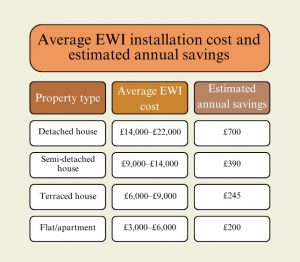
| Detached house | 120–160 m² | £14,000–£22,000 |
| Semi-detached | 90–110 m² | £9,000–£14,000 |
| Terraced house | 60–80 m² | £6,000–£9,000 |
| Flat/apartment | 30–50 m² | £3,000–£6,000 |
Actual project costs may vary based on wall condition, scaffolding needs, and regional labour rates.
Example cost breakdown for a 3-bedroom semi-detached home
- Materials (EPS or mineral wool boards): £3,500.
Labour and scaffolding: £5,000. - Render and finishing: £2,000.
- Miscellaneous/prep costs: £500.
Total: £11,000 (including VAT).
What affects the cost of external wall insulation?
Size of your home and total wall area
Larger properties need more material and labour, raising total costs. Every additional 10 m² can add up to £1,300 to your bill.
Type of insulation material
- EPS (Expanded Polystyrene): £90–£100/m² (most cost-effective).
- Mineral wool: £100–£120/m² (better fire/sound performance).
- Phenolic boards: £120–£140/m² (premium, thinnest for best U-values).
Choosing thicker boards for improved U-values provides better insulation but marginally boosts cost.
Labour, scaffolding, and finishing
Labour makes up a large part of house insulation prices. Silicone render is tough and long-lasting but more expensive than standard acrylic, and complex projects with lots of detailing can be costlier. London and the South East often see prices 10–15% above the UK average.
Additional costs: repairs, planning, and extras
- Wall repointing or repair: £500–£1,000 (if needed).
- Planning permission (conservation/listed): Check with your council.
- Yearly maintenance for render: Low, but occasional cleaning keeps it looking fresh.
External wall insulation cost comparison – with vs. without grants
Typical external wall insulation costs without a grant
Without financial support, homeowners typically spend between £9,000 and £20,000 for a full external insulation install, based on property size and materials.
Reduced external wall insulation costs after ECO4, GBIS, or local schemes
Thanks to ECO4 funding and the Great British Insulation Scheme (GBIS), eligible households can cut the cost by 40–100%, sometimes paying only a few thousand for a job that might otherwise cost much more.
Tip: Use the Eco Insulation Grant Calculator to check your eligibility and see how much you could save.
Long-term savings and payback period
How much can you save on energy bills each year?
Homes with solid external walls can reduce heat loss by up to 35% through proper external wall insulation. This can lead to savings between £200 and £700 per year on energy bills, depending on your property’s size, heating system, and insulation materials used.
Average payback time with and without a grant
Without a grant, the average payback time for external wall insulation usually takes around 10 to 15 years. With grant funding, this can drop to as little as five years, as your upfront cost is much lower. Without grant support, payback usually sits on the higher end of those ranges.
| Scenario | Payback time (no grant) | Payback time (with grant) |
| Detached house | 12–15 years | 8–10 years |
| Semi-detached house | 15–20 years | 7–8 years |
| Mid-terrace | 11–13 years | 5–7 years |
Carbon footprint and EPC rating improvements
Installing EWI can cut your home’s carbon emissions by up to 1.5 tonnes of CO₂ annually. It can also improve your EPC rating by one or more bands, a huge benefit for resale and rental value, particularly if switching from F or G up towards D or C, because heat loss is so much lower. For example, saving 7,000-9,500 kWh/year in energy (for a typical semi-detached house) can translate to savings up to £700/year and around 1,000 kg CO₂ reductions.
| Impact | Estimated CO₂ savings per year |
| Detached home with EWI | ~ 1,500 kg-2,100 kg CO₂ less per year |
| Semi-detached home | ~ 900-1,000 kg CO₂ saved per year |
How to reduce the cost of external wall insulation
Apply for insulation grants and local council schemes
ECO4 and the Great British Insulation Scheme are the main government programmes in 2025, potentially covering all or most of the installation cost for qualifying properties.
Combine with other energy-saving upgrades
Pairing EWI with loft insulation, new windows, or a high-performance heating system may unlock additional support, grants, or bulk discounts.
Choose the right installer and get multiple quotes
Always work with a TrustMark or PAS 2030-accredited installer for peace of mind, compliance, and warranty validity.
Eco Insulation offers free quotes and advice for comparing external wall insulation costs. You can find out more here.
Cost comparison – external vs internal wall insulation
- External wall insulation costs more upfront (£90–£150 per m²) but offers superior performance, upgraded home appearance, and preserves internal space.
- Internal insulation is cheaper (£60–£100 per m²) but reduces room sizes and may be disruptive if your household is living in during the works.
- For solid wall insulation in UK homes, external insulation is often the best long-term option for comfort, efficiency, and property value.
FAQs about external wall insulation costs
What’s the cheapest insulation material?
EPS boards are usually the most affordable and widely used option for EWI in the UK.
Does insulation add value to your home?
Improved EPC ratings and reduced running costs are attractive for buyers, tenants, and lending purposes.
Can I install external wall insulation myself?
DIY EWI is not recommended. Professional installation is vital for safety, warranty, compliance, and the required quality finish.
How long does installation take?
A typical semi-detached home takes two to three weeks, weather-dependent and based on project complexity.
Is external wall insulation worth the cost in 2025?
For most UK households, EWI is a reliable long-term investment, especially when you secure grant funding. You’ll see lower bills, improved comfort, and increased property value.
Next steps: get your free quote and grant check
If you’re considering external wall insulation and want to know your exact EWI installation cost or grant options, now’s the time to act.
Book a free, no-obligation quote and eligibility assessment with Eco Insulation. Enjoy a warmer, quieter, and more energy-efficient home for years to come.