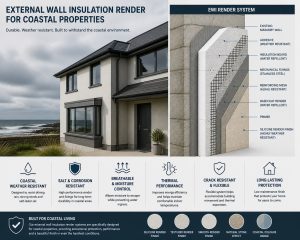
The render finish on an external wall insulation system does more than determine how the building looks. On an exposed or coastal property, it is the primary line of defence against driven rain, salt air, freeze thaw cycles, and wind loading that would destroy a poorly specified finish within a few years. Getting the external wall insulation render choice right on a difficult site is not a cosmetic decision, it is a structural one.
Why Exposure Classification Matters
Every EWI system specification should begin with an exposure assessment. The UK uses a driving rain index to classify locations by the volume and intensity of wind driven rain they receive. Broadly, exposed sites include:
Coastal locations: properties within a few kilometres of the coast, particularly on west and south west facing coastlines, experience some of the highest driving rain loads in the UK. Salt in the atmosphere accelerates the degradation of many external wall insulation render finishes and attacks the adhesive bonds within EWI systems.
Upland and moorland locations: high ground creates its own exposure conditions regardless of coastal proximity. Wind speeds are higher, rain is more frequent, and temperature ranges are wider.
Exposed urban elevations: a property in a city centre that sits on a corner or faces a wide open space can experience significantly higher exposure than a sheltered property on a narrow residential street in the same postcode.
The exposure classification determines not just which render finish is appropriate, but also the minimum insulation board thickness, the type of adhesive, the number and type of mechanical fixings, and the specification of the base coat and mesh.
An installer who applies the same specification to a sheltered suburban semi and a coastal property in Cornwall is not doing their job properly.
External Wall Insulation Render Systems Compared for Exposed Sites
Silicone Render
The standard choice for most UK EWI installations. Silicone render is flexible, hydrophobic, and highly resistant to cracking. It repels water while remaining vapour permeable, which allows the wall to breathe and prevents moisture from becoming trapped.
On moderately exposed sites, silicone render performs very well. On highly exposed coastal sites, it remains a valid choice but needs to be specified at the correct thickness, applied in suitable weather conditions, and finished with a fine texture that resists the accumulation of wind driven debris and biological growth.
Limitations on exposed sites: silicone render can discolour over time in coastal environments where salt and airborne algae create staining. Some manufacturers offer biocide treated silicone renders that resist biological growth more effectively in these conditions.
Mineral Render (Thin Coat)
A cement based render system with high vapour permeability. Mineral render requires painting after application and repainting every 10 to 15 years, which adds to the whole life cost compared to silicone. However, its hardness and resistance to impact make it a strong performer on sites exposed to wind driven debris.
On exposed sites, mineral render is often specified over mineral wool insulation boards, creating a fully non combustible system that also performs well where fire risk is a consideration, for example, buildings above 11 metres.
Limitations on exposed sites: mineral render is less flexible than silicone and more prone to fine cracking if there is any movement in the substrate. On sites with wide temperature ranges, movement joints need careful specification.
Monocouche Render
A through coloured, single coat render applied directly to the insulation boards. Not suitable for most EWI applications on exposed sites. Monocouche is designed for masonry substrates and does not perform reliably over insulation boards on high exposure elevations.
Brick Slip Finishes
On conservation areas or properties where a rendered finish is not acceptable, brick slip systems offer an alternative that replicates the appearance of brickwork. High quality brick slip systems use full depth slips rather than thin tile like slips, and bond them with a weather resistant adhesive and mortar.
On exposed sites, brick slip systems carry a higher risk of water ingress at the slip joints than a continuous render finish. They require careful specification and installation, particularly at the base of the system where water tracking down the face could enter at poorly pointed joints.
Cladding Systems
Timber, fibre cement, and metal cladding systems are alternatives to render on exposed properties. They fix to a frame or rail system over the insulation boards and create a rainscreen, a physical barrier that keeps the worst of the weather off the insulation and base coat behind it.
Rainscreen cladding is well suited to very high exposure sites and can be specified in materials that require minimal maintenance. The cavity behind the cladding must ventilate correctly to allow any moisture that enters to drain and evaporate.
Salt Air and Coastal Properties: Specific Risks
Salt air creates specific problems for EWI systems that do not apply inland.
Adhesive degradation. Some adhesives used to bond insulation boards to the substrate are more vulnerable to salt than others. A coastal specification should use adhesives tested and certified for use in marine environments.
Render surface attack. Salt crystals that form as sea spray evaporates can accumulate in the pores of a render surface and cause spalling. A dense, smooth render surface with good water repellency resists this better than a coarse textured finish.
Accelerated biological growth. The combination of salt, moisture, and mild temperatures on coastal sites creates ideal conditions for algae and lichen. A biocide treated render, or periodic treatment of the render surface, reduces the rate of growth. Some silicone renders include integrated algae resistance that performs for the first 10 to 15 years without additional treatment.
Fixings corrosion. Mechanical fixings that penetrate through the insulation into the substrate must be stainless steel or otherwise specified for a corrosive environment. Standard galvanised fixings corrode in coastal conditions, leaving rust staining on the render surface and eventually failing structurally.
Wind Loading on Exposed Sites
High wind sites create additional demands on the mechanical fixing specification. The number and pattern of fixings per square metre needs to increase on exposed elevations, particularly at the perimeter of the building where wind loads are highest.
A fixing pattern designed for a sheltered suburban location is not appropriate for a coastal property. The installer should carry out a wind load calculation, or use the BBA certificate for the chosen system to determine the correct fixing density for the site’s exposure classification.
On very exposed sites, the weight of the insulation and render system also needs consideration. Heavy systems, thick mineral wool boards with mineral render, create higher pull out loads on the fixings. The substrate pullout strength needs testing before installation begins to confirm it can support the system.
What to Ask an Installer on an Exposed Site
Before appointing an EWI installer for a coastal or exposed property, ask these specific questions:
What exposure classification have you assigned to this site, and how did you determine it? The answer should reference a recognised methodology, not a general impression.
Which render system are you specifying, and why is it appropriate for this exposure level? A credible answer names a specific product and explains its suitability.
What stainless steel fixings are you using, and what fixing density applies to the perimeter zones? If the installer cannot answer this, they have not done the structural design work.
What detailing are you using at the base, reveals, and eaves on this site? Exposed site detailing differs from standard practice and an experienced installer knows this.
Can you provide examples of EWI you have installed on similarly exposed sites? References from comparable projects are the strongest evidence of competence.
Frequently Asked Questions
Can EWI be installed on a property right on the seafront? Yes, but the system specification needs to be appropriate for the exposure level. Not all installers have experience working in coastal environments. The render, fixings, and adhesive all need to be specified for salt air exposure, and the installation needs to be carried out in suitable weather conditions.
How often does the render on an exposed EWI installation need maintenance? A silicone render in good condition on an exposed site should need no significant maintenance for 15 to 20 years. The render surface may benefit from cleaning every few years to remove algae and staining. Any sealant joints at window and door frames need inspection every 5 to 10 years and replacement when they show signs of cracking or separation.
Does exposure affect the insulation boards as well as the render? Not directly, the insulation boards sit behind the render and are protected from the weather. However, during installation, EPS and mineral wool boards must be protected from rain before the base coat is applied. An installer who leaves boards exposed on a wet coastal site risks compromising the insulation before the system is even complete.
Will EWI help with condensation on coastal properties? Yes. Solid wall properties in coastal locations often suffer condensation on cold external walls because the walls lose heat rapidly to the damp, windy outside air. EWI raises the temperature of the internal wall surface, which dramatically reduces the risk of condensation forming on it.
Find out if you qualify for a grant
 Information correct as of April 2026. Always commission an exposure assessment for coastal and upland properties before specifying an EWI system.