External wall insulation transforms the thermal performance of a solid wall property when installed correctly. When it goes wrong, the consequences range from cracking render and cold spots to sustained moisture ingress and structural damage. Understanding what causes external wall insulation failures, and what the published evidence says about them, helps homeowners choose the right system, the right installer, and the right specification for their property.
The Performance Gap: What the Data Says
The starting point for understanding external wall insulation problems is the gap between predicted and actual performance. Research published by the Building Research Establishment (BRE) on behalf of the government identified that actual energy savings from solid wall insulation are frequently lower than the modelled savings used to justify the investment.
Part of the reason is that the standard default U value assigned to solid brick walls in EPC calculations, 2.1 W/m²K, overstates heat loss in many properties. A reanalysis of 40 solid brick walls published in the journal Building Research and Information found a mean measured U value of 1.3 W/m²K, significantly better than the assumed figure. This matters because if the wall performs better than assumed before insulation, the calculated improvement from external wall insulation is also smaller than assumed.
This does not mean external wall insulation fails to deliver real world benefits, it does, particularly in comfort, draught reduction and condensation control. But it means the energy saving figures quoted at the point of sale deserve scrutiny, and homeowners should treat projected bill savings as estimates rather than guarantees.
The Most Common EWI (External Wall Insulation) Failure Modes
Render Cracking and Delamination
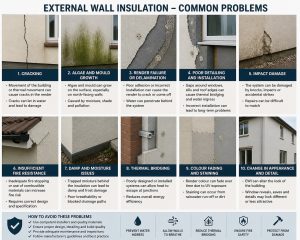
The most visible EWI problem. Cracks in the render finish can result from:
Movement at board joints. If the installer does not stagger the insulation board joints in a brick bond pattern, or if boards are not fixed tightly enough to eliminate movement, cracks form at the joints and telegraph through the render.
Inadequate base coat thickness. The reinforcing mesh must be fully embedded in the base coat render at the correct depth. Too thin a base coat leaves the mesh close to the surface, reducing impact resistance and allowing fine cracks to develop.
Insufficient expansion joints. Large unbroken render elevations expand and contract with temperature changes. An experienced installer specifies movement joints at regular intervals and at changes of material to accommodate this movement.
Incompatible products. EWI is a system, not a collection of individual products. Mixing boards, adhesives, base coats and finish coats from different manufacturers without checking compatibility is a known cause of adhesion failure and delamination.
Moisture Ingress at Details
The most damaging failure mode. Water gets behind the EWI system at poorly detailed junctions:
Around window and door openings. The junction between the EWI system and the window or door frame is a high risk area. Gaps here allow water to track behind the insulation and into the wall. Correct detailing uses purpose made beads, sealants compatible with the render system, and in some cases extended window sills.
At the base of the system. Where the insulation meets the ground, the base detail must include a starter track, adequate clearance from ground level, and a render stop that prevents water wicking upward into the system.
At the eaves. The junction between the top of the EWI and the soffit or bargeboard requires careful sealing to prevent water from tracking down behind the system.
At penetrations. Pipes, meters, and wall ties that penetrate the EWI system each represent a potential water entry point if not correctly collared and sealed.
Thermal Bridging at Junctions
EWI works by wrapping the building continuously in an insulating layer. Where that continuity breaks, at window reveals, at the base of the wall, at the roofline, thermal bridges remain. A poorly specified installation addresses the wall face but neglects the reveals, leaving cold bridges that continue to lose heat and can cause condensation on the inner face of the wall at those points.
A correctly specified installation insulates into reveals and forms clean junctions at every penetration of the insulated envelope.
Interstitial Condensation in Certain Wall Types
On some wall constructions, particularly those with a plasterboard dry lining already present, adding EWI to the outside can shift the dew point to a location within the wall construction where moisture accumulates. This is more likely where the wall already has multiple layers with different vapour permeability characteristics.
A competent installer surveys the wall construction before specifying the system and identifies whether any vapour control measures are needed.
What Makes an Installation Go Wrong
Most EWI failures trace back to one of three root causes.
Inadequate survey. An installer who quotes without visiting the property, or who visits but does not assess wall condition, substrate pullout strength, exposure rating, and existing defects, is setting up the installation to fail. The survey is where problems are identified and addressed before insulation boards go on.
Cost cutting on materials or labour. EWI installed under competitive grant funding pressure sometimes uses thinner boards, fewer fixings, or faster application than the specification requires. The result looks acceptable initially but fails within a few years.
Poor detailing at junctions. Most failures are detail failures rather than failures of the main insulation layer. An installer who does not have a practiced approach to window reveals, base details, eaves junctions, and penetrations creates vulnerabilities in every installation they complete.
How to Identify EWI Problems on an Existing Installation
If a property already has EWI and you suspect problems, these signs indicate investigation is needed:
Visible cracks in the render. Fine map cracking may be superficial. Cracks at regular intervals that follow the lines of board joints, or cracks at window and door corners, indicate more serious movement or detailing issues.
Damp patches on internal walls. Particularly on elevations facing prevailing rain. Damp that appears after rainfall and correlates with specific external locations suggests water entry through the EWI system.
Cold spots identified by thermal imaging. A thermal imaging survey of the internal walls in cold weather reveals areas where insulation is absent or where thermal bridging is significant. This is the most reliable diagnostic tool for assessing EWI performance.
Staining or biological growth on the render surface. Some staining is normal on exposed render, particularly on north facing elevations. Heavy biological growth can indicate a render surface that retains moisture longer than it should, which may point to a finish coat that has lost its water repellency.
Choosing an Installer to Avoid These Problems
The most reliable protection against EWI failure is installer quality. Look for:
PAS 2030 certification, the quality standard required for publicly funded EWI and the benchmark for technical competence in this sector.
TrustMark registration, the government endorsed quality scheme covering workmanship and complaint resolution.
BBA certification for the specific system, not just for insulation in general, but for the exact system being installed on your property.
A proper pre installation survey, any installer who quotes without visiting the property or who cannot explain how they will detail the window reveals, base, and eaves is not the right choice.
References from similar properties, ask for examples of EWI installed on properties of similar age, construction, and exposure to yours.
Frequently Asked Questions
How long should external wall insulation last? A correctly installed EWI system should last 25 to 40 years. The render finish may need cleaning or minor maintenance over that period but should not require significant remedial work within the first decade.
Can EWI be repaired if it fails? Minor render cracks can be filled and repainted. More significant failures, particularly those involving moisture ingress behind the insulation layer, typically require stripping back the affected section and reinstating it correctly, which is substantially more expensive than getting the installation right first time.
Does EWI always improve an EPC rating? Yes, though the extent of improvement depends on how much exposed wall the property has. A detached property with four external elevations sees a larger EPC improvement than a mid terrace with only front and rear elevations. The improvement also depends on what other measures are present, loft insulation, glazing and heating all affect the overall score.
Is cracking in EWI always a sign of failure? Not necessarily. Hairline shrinkage cracks in the first year after installation are common and generally superficial. Cracks that widen, cracks at board joints, or cracks that are accompanied by internal damp are more serious and warrant investigation.
Look at some of our real projects here.
 Information and data references correct as of April 2026. If you suspect EWI failure on an existing installation, commission a thermal imaging survey from a qualified assessor before deciding on remedial action.