Choosing the right external wall insulation system matters more in 2026 than it ever has before, and landlords with solid wall rental properties are feeling that pressure directly. The government confirmed in February 2026 that all privately rented homes in England and Wales must reach a minimum EPC rating of C by 1 October 2030, with fines of up to £30,000 per property for non-compliance. For properties that currently sit at D, E, or below, external wall insulation is frequently the single most effective measure available. Understanding which system suits your property is therefore not just a technical question. It is a compliance decision.
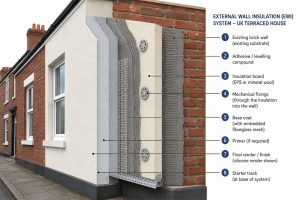
External wall insulation systems work by fixing an insulating layer to the outside of the building and finishing it with a protective coating. They do not reduce internal floor area, they improve the weatherproofing of the building fabric, and when correctly installed they can move a solid wall property up by one or even two EPC bands. The challenge is that not all systems are equal, and choosing the wrong one for your property type can cause damp, render failure, or a costly removal further down the line.
The Main Types of External Wall Insulation System
There are four systems in common use across UK residential properties. Each has its own thermal performance characteristics, cost profile, and suitability range.
- Mineral wool external wall insulation uses rockwool or glasswool boards fixed to the wall surface. It is breathable, which makes it well suited to older solid wall properties built before 1920 where moisture management through the wall is important. It handles impact well, it performs reliably in wet climates, and it is widely available from accredited installers. The typical U-value achievable depends on board thickness, but 100mm of mineral wool will generally move a solid wall from around 2.0 W/m2K down to 0.30 W/m2K or better, which is enough in most cases to contribute meaningfully to EPC improvement.
- EPS (expanded polystyrene) systems are the most common system used in the UK. They are lower in cost than mineral wool, they achieve excellent thermal performance per unit of thickness, and they are straightforward to install on most flat wall surfaces. The finish options are broad, from thin coat silicone render to brick-effect finishes. EPS is less breathable than mineral wool, so it is better suited to post-1920 properties with cavity walls where internal moisture movement is less of a concern.
- PIR (polyisocyanurate) board systems offer the highest thermal performance per millimetre of thickness. This makes them the right choice where wall depth is constrained, for example on properties close to the boundary where projecting further into the street is not possible. They are more expensive and require careful detailing at junctions to avoid cold bridging, but for difficult properties they are often the only system that achieves the required U-value without excessive thickness.
- Timber fibre systems are growing in use among conservation area properties and older buildings. Timber fibre is highly breathable, it handles moisture extremely well, and it is vapour open which suits historic fabric. It is typically the most expensive system and is not appropriate for all properties, but for listed buildings or those in sensitive locations where character must be preserved it is often the only system building control will accept.
Which System Is Right for a Landlord Under the 2030 Deadline
The answer depends on four factors: the construction type of the property, the current EPC rating, the wall depth available, and the finish requirements of the local planning authority.
For most Victorian and Edwardian terraced houses, which make up a large proportion of the private rented sector, mineral wool or timber fibre are the appropriate systems because the walls need to breathe. EPS on a solid wall property with no cavity can trap moisture and cause interstitial condensation if the system is not correctly detailed. A pre-installation survey by a PAS 2035 qualified assessor is essential before specifying any system.
For inter-war and post-war properties with cavity walls, EPS or PIR are generally appropriate. The cavity provides a moisture break, so breathability through the external leaf is less critical. EPS will achieve the required U-value in most cases at a lower cost than PIR.
For properties where planning restrictions limit projection, PIR is the system to specify. At 80mm, PIR can achieve a U-value of around 0.18 W/m2K, which is the same performance as 150mm of mineral wool. In conservation areas or on narrow terraces where every centimetre matters, this makes it the practical choice.
Cost and Funding in 2026
External wall insulation systems are not cheap. A typical semi-detached house will cost between £8,000 and £20,000 depending on system type, property size, and access requirements. For landlords with multiple properties, the cumulative cost of compliance is significant.
The good news is that funded support is still available in 2026. ECO4 runs until December 2026 and covers external wall insulation for eligible low income tenants. The Warm Homes Local Grant, delivered through local councils, is rolling out throughout the year and provides free or subsidised upgrades for qualifying households. For landlords whose tenants do not meet the eligibility criteria, the Warm Homes Fund is expected to offer low or zero interest loans later in 2026, giving a route to funded installation without requiring benefit status.
The cost cap under the new EPC C rules is £10,000 per property. If you spend up to that amount and still cannot reach EPC C, you can register for a compliance exemption. However, for most solid wall properties, external wall insulation installed to the correct specification will achieve EPC C within that budget, particularly if combined with other lower cost measures such as loft insulation or heating controls.
Acting now, rather than in 2028 or 2029, means accessing installer capacity before demand peaks, avoiding the material price inflation that typically accompanies deadline-driven surges, and securing grant funding that may not be available indefinitely.
Find out more about us and our services.