When your home has solid walls, you face a genuine decision. External wall insulation vs internal wall insulation are both valid solutions, but they work differently, cost differently, and suit different situations. This guide helps you understand both options clearly so you can make the right call for your property in 2026.
Why Solid Wall Homes Need a Different Approach
Cavity wall homes can be insulated by injecting material into the existing gap between the two layers of brick. Solid wall homes have no such gap. As a result, insulation must go either on the outside of the building or on the inside of the external walls.
This is not a minor distinction. The choice you make affects your budget, your living space, your planning permission requirements, and your EPC rating improvement. Getting it right from the start saves a significant amount of time and money.
What Is External Wall Insulation?
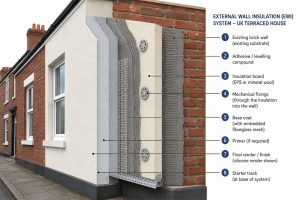
External wall insulation, or EWI, involves fixing a layer of insulating material to the outside of the building and covering it with a protective render or cladding system. The insulation wraps the building like a thermal coat.
The most common materials used are expanded polystyrene boards, mineral wool, or phenolic foam. Each has different thermal performance characteristics and price points. Your installer will recommend the right material based on your wall construction and target U-value.
Because the insulation sits outside the building fabric, it does not reduce the internal floor area. This is one of the key advantages over internal insulation.
What Is Internal Wall Insulation?
Internal wall insulation involves fixing insulating boards or a stud wall filled with insulation to the inside face of external walls. The insulation sits behind a new plasterboard finish, which means the wall effectively moves inward.
The most common materials used are rigid insulation boards bonded directly to the wall, or a timber or metal stud frame packed with mineral wool or rigid insulation. Both approaches require the room to be redecorated after installation.
Internal wall insulation is generally cheaper to install than external wall insulation on a per-square-metre basis. However, the hidden costs accumulate quickly.
Cost Comparison: External vs Internal Wall Insulation in 2026
External wall insulation typically costs between £8,000 and £22,000 for a standard semi-detached property in 2026, depending on the size of the property, the insulation material, and the finish. This is a significant upfront investment.
Internal wall insulation costs less per square metre to install, typically between £4,000 and £14,000 for the same property. However, this figure does not include the cost of moving radiators, skirting boards, electrical sockets, window reveals, or the full redecoration that follows installation. When these additional costs are included, the gap between the two options narrows considerably.
For homeowners eligible for government grant funding, external wall insulation may attract support under schemes such as ECO4. You can check current eligibility at gov.uk (https://www.gov.uk). Grant funding can significantly reduce the net cost of EWI and makes it the more affordable option for qualifying households.
Disruption: Which Option Is More Disruptive?
This is where the two options diverge most sharply depending on your circumstances.
External wall insulation causes minimal internal disruption. Work takes place on the outside of the building. You continue to live in the property throughout the installation in most cases. The process typically takes between one and three weeks for a standard house.
Internal wall insulation is far more disruptive to daily life. Each external wall that receives insulation requires the room to be stripped back, the insulation to be fitted, and the room to be fully redecorated. Radiators, sockets, window sills, and skirting boards all need to be removed and refitted. If you insulate all external walls, the entire house effectively becomes a building site.
For families with young children, people who work from home, or anyone who cannot easily vacate the property, this level of disruption is a serious practical consideration.
Impact on Floor Space
Internal wall insulation reduces the internal floor area of your home. The insulation boards and new plasterboard layer typically add between 80mm and 120mm to the internal face of each external wall. In a small room, this is noticeable.
External wall insulation has no impact on internal floor space at all. The building footprint increases slightly on the outside, but rooms remain exactly as they were.
For properties in urban areas or homes where rooms are already compact, this can be a deciding factor.
Planning Permission
External wall insulation changes the external appearance of a property. In most cases it does not require planning permission under permitted development rules. However, if your property is in a conservation area, is a listed building, or is part of a terrace where neighbours have not installed EWI, you may need to apply.
Internal wall insulation does not change the external appearance and therefore does not require planning permission in any standard residential situation.
If you live in a conservation area or a listed building, internal wall insulation is often the only realistic option. Your installer should check permitted development rights before work begins.
EPC Rating Improvement
Both options improve your EPC rating, but external wall insulation typically delivers a greater improvement. This is because it eliminates thermal bridging at the junctions between floors, ceilings, and walls more effectively than internal insulation.
A solid wall property currently rated E or F can often reach C or above with a full EWI installation. Internal wall insulation can achieve similar results in some cases, but only when every external wall is treated. Partial internal insulation leaves cold bridges at junctions and delivers a smaller overall improvement.
For landlords approaching the 2030 minimum EPC requirement of C for new tenancies, external wall insulation is often the more reliable route to compliance. You can check the minimum rating requirements at gov.uk (https://www.gov.uk).
For more on how EPC ratings work and what they mean for landlords and homeowners, visit epccertificates.co.uk.
Which Option Is Right for Your Home?
External wall insulation suits you if:
You want minimal internal disruption. You want to protect your internal floor space. Your property is not in a conservation area. You are aiming for a significant EPC rating improvement. You may be eligible for grant funding.
Internal wall insulation suits you if:
Your property is in a conservation area or is listed. You are on a tighter budget and cannot access grant funding. You are happy to manage the internal disruption room by room. You only need to treat one or two walls rather than the whole house.
For most solid wall homeowners in 2026, external wall insulation delivers better long-term value when the full picture is considered. The upfront cost is higher, but the thermal performance, the absence of internal disruption, and the stronger EPC rating improvement make it the preferred choice for whole-house treatment.
For properties where floor insulation is also a consideration alongside wall insulation, visit floorinsulation.co.uk (https://www.floorinsulation.co.uk) for a full overview of your options.
 If you are still weighing up external wall insulation vs internal wall insulation for your property, contact us today. We assess your home, explain your options clearly, and provide a no-obligation quote so you can make an informed decision.