External wall insulation Bristol homeowners consider often comes down to two things. Many Bristol properties have solid Georgian or Victorian walls. Many also sit close to the Avon estuary, where weather exposure is a real factor. This guide covers what Bristol homeowners need to know before booking a survey in 2026.
Why Bristol properties need a weather aware approach
Bristol sits on the tidal Avon, close to the Severn estuary. As a result, it sees more driving rain and salt laden air than many inland cities. Therefore, the render system used matters more here than in a sheltered location. A system rated for a low exposure zone will not perform well facing the estuary weather.
Consequently, installers working in Bristol need to assess exposure street by street. They should not apply one standard specification across the whole city. A terrace in Clifton facing open ground may need a different system to a sheltered street a mile away.
For a full breakdown of render systems suited to coastal and exposed properties, our guide to external wall insulation render explains how to choose the right specification.
What does external wall insulation cost in Bristol
Costs for external wall insulation Bristol homeowners pay follow the same broad structure as elsewhere in the UK. However, a higher exposure render specification tends to sit above the standard price. Many Bristol properties need this higher spec. In addition, scaffolding access can be a factor on Bristol’s steep terraced streets. This is especially true in areas like Totterdown and parts of Bedminster.
For example, a straightforward semi in a sheltered suburb will cost less than a solid wall terrace on an exposed hillside street. Consequently, it is worth asking any installer to confirm the exposure rating they are pricing for. A lower spec quote may not hold up once the wind and rain set in.
External wall insulation Bristol quotes should always state the exposure category clearly. Therefore, if a quote does not mention it, ask before agreeing to anything.
Conservation areas and planning permission in Bristol
Bristol has a significant number of conservation areas. These include much of Clifton, parts of Redland and the Georgian terraces around Clifton Wood. In these areas, external wall insulation can still be possible. However, it usually needs planning permission, because it changes the appearance of the building from the street.
Furthermore, some Bristol properties are listed buildings. External wall insulation is rarely straightforward here, and it often needs specialist advice before any application. Outside conservation areas and listed buildings, most homeowners can proceed under permitted development rights. Even so, it is always worth a quick check with the council planning team first.
Grants and funding available to Bristol homeowners
Most funding support for external wall insulation Bristol households can access comes through the Warm Homes: Local Grant. This is a government funded scheme delivered through local authorities across England. Eligibility usually depends on household income, certain benefits, or living in a qualifying postcode area. Your home will also generally need an EPC rating of D or below.
For a clear explanation of solid wall construction, and how external insulation is fitted, the Energy Saving Trust has detailed guidance worth reading before your survey.
Therefore, it is worth checking your EPC rating before applying, since this affects what support is on offer. If you are also weighing up damp issues linked to wall insulation more broadly, our sister site has a detailed explainer on the north facing elevation problem. It is worth reading alongside any Bristol specific quote.
Finding a trusted installer for external wall insulation in Bristol
Because Bristol properties face such varied weather exposure, the survey matters as much as the installer. Look for a company registered with a recognised competent person scheme. In addition, ask specifically how they assess exposure before specifying a render system. A good installer will explain why they chose a particular finish for your street, not just apply their standard package.
Furthermore, ask to see examples of similar properties they have completed nearby. Ideally, these should be in a comparable position relative to the estuary. Therefore, a Bristol facing terrace and a sheltered inland street should never receive identical quotes for identical looking walls. The underlying exposure risk is simply different.
Is external wall insulation worth it for a Bristol home
For most solid wall properties in Bristol, external wall insulation pays back through lower heating bills and a more comfortable home. It also raises the EPC rating. However, the added cost of a higher exposure render system means the payback period can run longer than in a sheltered part of the country.
As a result, it makes sense to weigh the higher upfront specification against the protection it offers over the long term. This matters given how much weather a Bristol facing property can take over a typical British winter.
When to book external wall insulation work in Bristol
Many Bristol installers get busy quickly once autumn weather arrives. Therefore, booking a survey in spring or summer often means shorter waits and better availability. In addition, render needs dry weather to cure properly, so a summer installation reduces the risk of delays caused by rain.
However, if your main concern is grant eligibility rather than weather, timing matters less. Even so, booking ahead of the seasonal rush still tends to secure a better price, since demand for installers rises sharply once the weather turns colder.
How Bristol compares with other English cities for external wall insulation
Average exposure levels in Bristol tend to run higher than inland cities such as Leeds or Birmingham, mainly because of its position near the Severn estuary. As a result, Bristol quotes often include a higher spec render as standard, which is not always the case elsewhere. Consequently, comparing a Bristol quote directly against a quote from a more sheltered city can be misleading unless both specify the same exposure rating.
Furthermore, Bristol’s large stock of Georgian and Victorian solid wall terraces means demand for external wall insulation remains consistently high across the year. Therefore, booking early is worth doing regardless of season, simply because good installers in the city tend to have a longer lead time than in less densely built areas.
Common questions Bristol homeowners ask before booking
Many Bristol homeowners ask whether external wall insulation will change how their street looks. In most cases, a good render finish can closely match the existing facade, especially in stone effect or brick slip styles common across the city. Therefore, this is rarely a reason to rule the system out on its own.
Others ask how long the work takes on a typical Bristol terrace. A standard three bedroom property usually takes one to two weeks from scaffolding going up to the final render coat curing. However, exposed sites near the water may need extra drying time between coats, so it is worth building some flexibility into your plans.
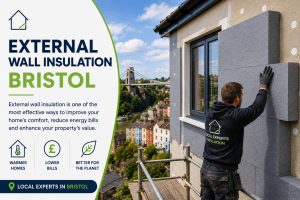 Get a free quote for external wall insulation in Bristol
If you are ready to find out what external wall insulation could cost for your Bristol property, get a free, no obligation quote from a local accredited installer. A survey will confirm the right exposure rated specification for your home. It will also confirm the funding you may qualify for, and a clear price before any work begins.