We use cookies to provide you with a better experience. By continuing to use this site, you agree to our use of cookies.

External Wall Insulation Installers: What to Look For When Access Is Difficult (2026)

Choosing external wall insulation installers is straightforward when a property sits in an open plot with clear access on all sides. It becomes considerably more complicated when the property is a narrow plot semi with a 600mm gap between the gable wall and the boundary fence, a front elevation directly onto the pavement, or a rear garden accessible only through the house. Restricted access does not make EWI (external wall insulation) impossible, but it does separate installers who genuinely know what they are doing from those who prefer to avoid it.


Why Access Matters More Than Most Homeowners Realise

EWI requires scaffolding on every elevation being insulated. Scaffolding requires a base to stand on, clearance to erect, and usually a licence from the local authority if it occupies the pavement or road. On a straightforward property, none of this is complicated. On a narrow plot semi, it can be the single biggest cost and logistical variable in the project.


The access situation also affects:


Which system can be installed. Thicker insulation boards need more room to manoeuvre. On a very narrow gable, a thinner high performance board such as PIR or phenolic may be the only practical option to achieve the required U value within the available working space.


How long the installation takes. Restricted access slows every stage of the job, board delivery, fixing, rendering, and inspection. An installer who does not factor this into the programme will overrun.


What the scaffolding costs. A licence for pavement scaffolding, specialist access equipment, or a narrow tube scaffold system on a restricted gable all cost more than standard scaffolding. An installer who does not disclose this upfront leaves the homeowner with a surprise invoice.


Whether a building regulations inspector can access the installation. Building regulations sign off requires inspection of the system as it goes on. If the inspector cannot physically access a section of the building, sign off is delayed or compromised.


The External Wall Insulation Installers’ Narrow Gable Problem

The most common access challenge on semi detached houses is the side gable, the exposed external wall between the property and the boundary. On a typical 1930s or 1940s semi, this gap can be as little as 600 to 900mm, sometimes less where extensions or outbuildings reduce it further.


Standard scaffold tubes need approximately 600mm of clearance from the wall face to erect a working scaffold. Adding 100mm of insulation to the wall face reduces the available clearance by 100mm before the scaffold is even erected. On a 600mm gap, this creates a situation where standard scaffold cannot be erected once the insulation is in place, meaning the sequence of works needs careful planning to avoid trapping the scaffold inside the insulation zone.


Experienced installers handle this with one of several approaches:


Monopitch scaffold. A single pitch scaffold fixed to the wall itself rather than freestanding, which requires less floor clearance. This needs the wall substrate to be assessed for fixing strength before erection.


Tower scaffold or mobile elevated work platforms (MEWPs). On very restricted gables, a tower scaffold moved along the length of the gable section by section can replace a full run scaffold. MEWPs, cherry pickers or scissor lifts, are sometimes used where even a tower will not fit, though they require level ground and sufficient overhead clearance.


Sequence planning. On some sites, the scaffold erects before the insulation on the restricted elevation, the insulation installs, and the scaffold strikes before the render. The render on that elevation applies from inside the gap using extension tools. This requires careful coordination and an installer experienced in working in confined spaces.


Thin board specification. Where the gap genuinely cannot accommodate standard scaffold plus a 100mm board, switching to a 60mm phenolic board achieves a similar U value in less space. The system cost is higher but avoids an access impasse.

The right external wall insulation installers can make or break your project.


Front Elevations Onto the Pavement

Many pre war terraced and semi detached properties have a front elevation that sits directly on the pavement line, with no garden or forecourt between the building and the public footway. Adding EWI to this elevation brings the new render face onto or over the pavement.


This creates two issues. First, the scaffold occupies the pavement and requires a pavement licence from the local authority. Second, the new render face may protrude beyond the building line, which can require planning permission even where EWI normally falls within permitted development.


An experienced installer navigates both. The pavement licence application is standard practice in urban areas, most local authorities process them routinely and charge a standard fee. The planning question needs checking with the local planning authority before work starts.


On very narrow pavements where a scaffold cannot be licensed without completely blocking the footway, the programme may need to work around peak footfall periods, use overhead protection gantries, or phase the front elevation separately from the rest of the installation.


Rear Access Through the Property

Properties with no side access have their rear garden reachable only through the house or over the boundary. This affects the delivery of materials, insulation boards, render bags, tools, which need to come through the house or over the fence.


A professional installer factors this in at survey stage. Materials split into smaller loads that can be carried through the house without damaging floors, walls or door frames. Protection goes down on floor surfaces before any materials move through. The sequence plans for the materials needed on the rear elevation to arrive before internal access becomes restricted by other works.


An installer who does not raise this at survey stage has not thought it through. Ask specifically how they plan to get materials to the rear of the property.


Questions to Ask External Wall Insulation Installers on a Restricted Access Site

Have you surveyed the gable gap and determined what scaffold system you will use? If they cannot tell you specifically, they have not solved the problem yet.


Who arranges the pavement licence and what does it cost? This should be the installer’s responsibility to organise, with the cost included in or clearly itemised in the quote.


How do you handle material delivery to restricted rear elevations? The answer should be specific about protection, sequencing and load sizes.


What is the contingency if the scaffold cannot be erected as planned? A good installer has thought about this before arriving on site.


Does your quote include all access costs, or are scaffold and licence costs additional? Get this in writing before appointing.


Red Flags to Watch For

A quote produced without a site visit. Restricted access problems are invisible from a satellite image or street view photograph. Any installer who quotes without visiting has not assessed the access situation.


A quote that does not mention scaffold or access at all. This is either an oversight or a sign that access costs will appear as extras later.


An installer who says restricted access is not a problem without explaining how they will handle it. This is reassurance without substance. Ask them to be specific.


A price that is significantly lower than other quotes on a difficult access site. Low prices on restricted access jobs often mean the installer has undercosted the access element and will either claim extras or cut corners on the installation to recover margin.


Frequently Asked Questions

Does restricted access affect the building regulations sign off? It can. The building regulations inspector needs to be able to view the installation at key stages, insulation fixed, base coat and mesh applied, before the finish coat. If they cannot physically access a section, they may require photographic evidence taken at each stage by the installer. Agree this with the inspector before work starts.


Can EWI be installed in sections on a restricted site? Yes, but it requires careful detailing at the junctions between sections. The render finish needs to be continuous across the whole elevation to perform correctly. Phased installation that leaves unrendered sections exposed for extended periods risks moisture getting into the boards.


Will restricted access always cost more? Usually yes, though the extent depends on the specific situation. Pavement licences are a modest fixed cost. Specialist scaffold or MEWP hire on a very restricted gable can add several hundred to a few thousand pounds to the project cost. Get this itemised in the quote rather than finding out after.


Does the neighbour need to give access for the gable wall? Where the gable wall sits on or close to the boundary, the scaffold base may need to stand on the neighbour’s land. This requires the neighbour’s permission in advance. An experienced installer raises this at survey stage and advises on how to approach the conversation.

Check out some real projects

IExternal wall lightsnformation correct as of April 2026. Always insist on a site visit from any installer before accepting a quote on a restricted access property.

 

Is External Wall Insulation Worth It? A Honest Assessment for UK Homeowners (2026)

External wall insulation is one of the most expensive energy efficiency upgrades a homeowner can make. It is also, for the right property, one of the most transformative. The question is external wall insulation is worth it does not have a single answer, it depends on what your walls are made of, how you heat your home, whether you qualify for funding, and what you value most: lower bills, greater comfort, a better EPC rating, or all three.


This article works through each of those factors honestly, including the parts that are sometimes glossed over.


When External Wall Insulation Is Clearly Worth It

Your property has solid walls and no other insulation option

If your home was built before the 1920s, it almost certainly has solid brick or stone walls with no cavity. There is no cavity to fill. Your only options are external wall insulation or internal wall insulation, and for most solid wall properties, external wall insulation is the stronger technical solution.


Uninsulated solid walls lose heat at a rate of approximately 2.1 W/m²K. A correctly installed external wall insulation system brings that down to around 0.30 W/m²K, a sevenfold improvement. Nothing else you can do to a solid wall property comes close to that impact.

You qualify for fully funded installation

For households that qualify under ECO4 or the Great British Insulation Scheme, external wall insulation costs nothing. Zero outlay, sevenfold improvement in wall thermal performance, significant EPC rating improvement, and lower heating bills for decades. In this scenario the question of whether external wall insulation is worth it barely needs asking.


A solid brick semi rated E or F on its EPC has a strong chance of qualifying. A conversation with a TrustMark registered, PAS 2030 certified installer takes around 30 minutes and tells you definitively whether funding is available.

Your EPC rating is blocking a sale or a remortgage

EPC ratings increasingly influence property values, mortgage product availability, and, for landlords, legal compliance. A solid wall property rated E or F that cannot be sold, let, or refinanced on favourable terms has a more urgent version of the EWI (external wall insulation) question. The cost of not improving the rating can exceed the cost of the EWI itself over a relatively short period.

Comfort is your primary concern

This is underappreciated in discussions that focus only on bill savings. Homeowners who have lived through winters in a poorly insulated solid wall house know what cold walls, draughts, and surface condensation feel like. EWI eliminates all of these. Internal wall surfaces become warmer. Rooms heat up faster. The heating system maintains temperature with less effort. For many homeowners, the comfort improvement alone justifies the investment.


When the Calculation Is Less Clear

Your property has cavity walls

Cavity wall insulation costs a fraction of EWI and delivers meaningful thermal improvement. If your home has an unfilled cavity, filling it is the obvious first step. EWI on a cavity wall property rarely makes economic sense unless the cavity fill has failed or the property has other specific requirements.

You plan to sell within a few years

The evidence on EWI and property value is mixed. Government research found that EWI tends to increase property value, but that the increase is primarily driven by improved external appearance rather than energy efficiency per se. The average value uplift does not reliably cover the cost of a privately funded EWI installation in the short term. If you are planning to sell within three to five years and are paying the full cost yourself, the financial case for EWI is weaker.

You are in a conservation area or have a listed property

Planning constraints can limit the system types available, require more expensive finishes, or, in some cases, make EWI impossible without consent that may not be granted. Check with your local planning authority before progressing any further.


The Bill Saving Reality

The Energy Saving Trust estimates annual savings of £280 to £400 for a typical semi detached solid wall property following EWI installation. These figures use 2026 average energy prices and assume the property was previously uninsulated.


If you pay the full cost of EWI privately, say £10,000 to £14,000 for a solid brick semi, the payback period on energy savings alone is around 25 to 40 years. That is a long time.


The financial case for self funded EWI rests not on energy savings alone but on the combination of:


Energy savings, real but modest on their own relative to the capital cost.


EPC rating improvement, moving from E or F to C has a measurable effect on property value and mortgage product availability that is difficult to quantify precisely but is increasingly significant.


Comfort value, cold, draughty rooms are a real quality of life issue and the elimination of them has genuine value that does not appear in bill saving calculations.


Avoided maintenance, EWI often replaces deteriorating render or repointing work that would be needed regardless. The net cost of EWI is lower than the headline figure when you subtract the maintenance cost it replaces.


Grant funding, for eligible households, the self funded scenario is irrelevant. The full cost is covered.


The Honest Downsides

It changes the appearance of your home. The brickwork disappears behind render. On most residential streets this is unremarkable, but on some properties it matters significantly to the owner. You cannot undo it.


It is disruptive. Scaffolding goes up around the property for two to four weeks. Access to windows, doors, and external pipes is restricted during the installation. Neighbours on a terrace may be affected by scaffold, noise, and activity.


Poor installation causes real problems. EWI that is badly detailed at junctions or installed with the wrong system for the site’s exposure can cause moisture ingress, render cracking, and sustained damage. Choosing a well qualified installer is not optional.


The EPC improvement may be less than expected. If the property has already had loft insulation, double glazing, and a modern boiler, the EWI may add fewer EPC points than the same measures would have on an unimproved property. Check the potential rating on your existing EPC before deciding.


The Verdict

For a solid wall property with an unimproved EPC, particularly one that qualifies for grant funding, EWI is worth it. The thermal performance improvement is dramatic, the comfort gain is real and immediate, and the cost is zero or heavily subsidised for a large proportion of eligible households.


For a self funded installation on a property that is already reasonably efficient, the financial case depends on how long you plan to stay, how much you value the comfort improvement, and what your EPC rating means for your specific circumstances.


The first step is always the same: find out what your property qualifies for. The funding landscape changes that calculation entirely for many homeowners.


Frequently Asked Questions

How much does external wall insulation cost without a grant? For a solid brick semi detached house, expect £9,000 to £14,000 for a standard EPS system with silicone render, including scaffolding. Larger or more complex properties cost more. Costs in 2026 vary by installer and location.


How much can I save on bills after EWI? The Energy Saving Trust estimates £280 to £400 per year for a typical semi detached solid wall property. A larger or detached property with more exposed wall will see higher savings. A mid terrace with limited exposed wall will see less.


How much will EWI improve my EPC rating? Typically 10 to 25 points, depending on how much exposed wall the property has and what other measures are already present. A detached property can see larger improvements. A mid terrace, less so. Check your current EPC’s recommended improvements table for a property specific estimate.


Does EWI add value to my home? Government research found a positive relationship between EWI and property value, primarily linked to improved external appearance. The value uplift is not guaranteed to cover the installation cost but does contribute to the overall case for investment alongside energy savings and comfort.


How do I know if I qualify for a grant? Contact a TrustMark registered, PAS 2030 certified installer and ask them to run an eligibility check. This costs nothing and covers ECO4, GBIS, and any local authority schemes available in your area.


External wall insulation examplesCosts and savings figures correct as of April 2026. Grant eligibility criteria and funding levels change regularly, always confirm current availability with a registered installer.
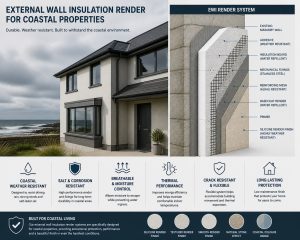
 

External Wall Insulation Render: Choosing the Right System for Coastal and Exposed Properties (2026)

The render finish on an external wall insulation system does more than determine how the building looks. On an exposed or coastal property, it is the primary line of defence against driven rain, salt air, freeze thaw cycles, and wind loading that would destroy a poorly specified finish within a few years. Getting the external wall insulation render choice right on a difficult site is not a cosmetic decision, it is a structural one.


Why Exposure Classification Matters

Every EWI system specification should begin with an exposure assessment. The UK uses a driving rain index to classify locations by the volume and intensity of wind driven rain they receive. Broadly, exposed sites include:


Coastal locations: properties within a few kilometres of the coast, particularly on west and south west facing coastlines, experience some of the highest driving rain loads in the UK. Salt in the atmosphere accelerates the degradation of many external wall insulation render finishes and attacks the adhesive bonds within EWI systems.


Upland and moorland locations: high ground creates its own exposure conditions regardless of coastal proximity. Wind speeds are higher, rain is more frequent, and temperature ranges are wider.


Exposed urban elevations: a property in a city centre that sits on a corner or faces a wide open space can experience significantly higher exposure than a sheltered property on a narrow residential street in the same postcode.


The exposure classification determines not just which render finish is appropriate, but also the minimum insulation board thickness, the type of adhesive, the number and type of mechanical fixings, and the specification of the base coat and mesh.


An installer who applies the same specification to a sheltered suburban semi and a coastal property in Cornwall is not doing their job properly.


External Wall Insulation Render Systems Compared for Exposed Sites

Silicone Render

The standard choice for most UK EWI installations. Silicone render is flexible, hydrophobic, and highly resistant to cracking. It repels water while remaining vapour permeable, which allows the wall to breathe and prevents moisture from becoming trapped.


On moderately exposed sites, silicone render performs very well. On highly exposed coastal sites, it remains a valid choice but needs to be specified at the correct thickness, applied in suitable weather conditions, and finished with a fine texture that resists the accumulation of wind driven debris and biological growth.


Limitations on exposed sites: silicone render can discolour over time in coastal environments where salt and airborne algae create staining. Some manufacturers offer biocide treated silicone renders that resist biological growth more effectively in these conditions.

Mineral Render (Thin Coat)

A cement based render system with high vapour permeability. Mineral render requires painting after application and repainting every 10 to 15 years, which adds to the whole life cost compared to silicone. However, its hardness and resistance to impact make it a strong performer on sites exposed to wind driven debris.


On exposed sites, mineral render is often specified over mineral wool insulation boards, creating a fully non combustible system that also performs well where fire risk is a consideration, for example, buildings above 11 metres.


Limitations on exposed sites: mineral render is less flexible than silicone and more prone to fine cracking if there is any movement in the substrate. On sites with wide temperature ranges, movement joints need careful specification.

Monocouche Render

A through coloured, single coat render applied directly to the insulation boards. Not suitable for most EWI applications on exposed sites. Monocouche is designed for masonry substrates and does not perform reliably over insulation boards on high exposure elevations.

Brick Slip Finishes

On conservation areas or properties where a rendered finish is not acceptable, brick slip systems offer an alternative that replicates the appearance of brickwork. High quality brick slip systems use full depth slips rather than thin tile like slips, and bond them with a weather resistant adhesive and mortar.


On exposed sites, brick slip systems carry a higher risk of water ingress at the slip joints than a continuous render finish. They require careful specification and installation, particularly at the base of the system where water tracking down the face could enter at poorly pointed joints.

Cladding Systems

Timber, fibre cement, and metal cladding systems are alternatives to render on exposed properties. They fix to a frame or rail system over the insulation boards and create a rainscreen, a physical barrier that keeps the worst of the weather off the insulation and base coat behind it.


Rainscreen cladding is well suited to very high exposure sites and can be specified in materials that require minimal maintenance. The cavity behind the cladding must ventilate correctly to allow any moisture that enters to drain and evaporate.


Salt Air and Coastal Properties: Specific Risks

Salt air creates specific problems for EWI systems that do not apply inland.


Adhesive degradation. Some adhesives used to bond insulation boards to the substrate are more vulnerable to salt than others. A coastal specification should use adhesives tested and certified for use in marine environments.


Render surface attack. Salt crystals that form as sea spray evaporates can accumulate in the pores of a render surface and cause spalling. A dense, smooth render surface with good water repellency resists this better than a coarse textured finish.


Accelerated biological growth. The combination of salt, moisture, and mild temperatures on coastal sites creates ideal conditions for algae and lichen. A biocide treated render, or periodic treatment of the render surface, reduces the rate of growth. Some silicone renders include integrated algae resistance that performs for the first 10 to 15 years without additional treatment.


Fixings corrosion. Mechanical fixings that penetrate through the insulation into the substrate must be stainless steel or otherwise specified for a corrosive environment. Standard galvanised fixings corrode in coastal conditions, leaving rust staining on the render surface and eventually failing structurally.


Wind Loading on Exposed Sites

High wind sites create additional demands on the mechanical fixing specification. The number and pattern of fixings per square metre needs to increase on exposed elevations, particularly at the perimeter of the building where wind loads are highest.


A fixing pattern designed for a sheltered suburban location is not appropriate for a coastal property. The installer should carry out a wind load calculation, or use the BBA certificate for the chosen system to determine the correct fixing density for the site’s exposure classification.


On very exposed sites, the weight of the insulation and render system also needs consideration. Heavy systems, thick mineral wool boards with mineral render, create higher pull out loads on the fixings. The substrate pullout strength needs testing before installation begins to confirm it can support the system.


What to Ask an Installer on an Exposed Site

Before appointing an EWI installer for a coastal or exposed property, ask these specific questions:


What exposure classification have you assigned to this site, and how did you determine it? The answer should reference a recognised methodology, not a general impression.


Which render system are you specifying, and why is it appropriate for this exposure level? A credible answer names a specific product and explains its suitability.


What stainless steel fixings are you using, and what fixing density applies to the perimeter zones? If the installer cannot answer this, they have not done the structural design work.


What detailing are you using at the base, reveals, and eaves on this site? Exposed site detailing differs from standard practice and an experienced installer knows this.


Can you provide examples of EWI you have installed on similarly exposed sites? References from comparable projects are the strongest evidence of competence.


Frequently Asked Questions

Can EWI be installed on a property right on the seafront? Yes, but the system specification needs to be appropriate for the exposure level. Not all installers have experience working in coastal environments. The render, fixings, and adhesive all need to be specified for salt air exposure, and the installation needs to be carried out in suitable weather conditions.


How often does the render on an exposed EWI installation need maintenance? A silicone render in good condition on an exposed site should need no significant maintenance for 15 to 20 years. The render surface may benefit from cleaning every few years to remove algae and staining. Any sealant joints at window and door frames need inspection every 5 to 10 years and replacement when they show signs of cracking or separation.


Does exposure affect the insulation boards as well as the render? Not directly, the insulation boards sit behind the render and are protected from the weather. However, during installation, EPS and mineral wool boards must be protected from rain before the base coat is applied. An installer who leaves boards exposed on a wet coastal site risks compromising the insulation before the system is even complete.


Will EWI help with condensation on coastal properties? Yes. Solid wall properties in coastal locations often suffer condensation on cold external walls because the walls lose heat rapidly to the damp, windy outside air. EWI raises the temperature of the internal wall surface, which dramatically reduces the risk of condensation forming on it.

Find out if you qualify for a grant

external wall insulation renderInformation correct as of April 2026. Always commission an exposure assessment for coastal and upland properties before specifying an EWI system.


External Wall Insulation Problems: What the Data Shows and How to Avoid Them (2026)

External wall insulation transforms the thermal performance of a solid wall property when installed correctly. When it goes wrong, the consequences range from cracking render and cold spots to sustained moisture ingress and structural damage. Understanding what causes external wall insulation failures, and what the published evidence says about them, helps homeowners choose the right system, the right installer, and the right specification for their property.


The Performance Gap: What the Data Says

The starting point for understanding external wall insulation problems is the gap between predicted and actual performance. Research published by the Building Research Establishment (BRE) on behalf of the government identified that actual energy savings from solid wall insulation are frequently lower than the modelled savings used to justify the investment.


Part of the reason is that the standard default U value assigned to solid brick walls in EPC calculations, 2.1 W/m²K, overstates heat loss in many properties. A reanalysis of 40 solid brick walls published in the journal Building Research and Information found a mean measured U value of 1.3 W/m²K, significantly better than the assumed figure. This matters because if the wall performs better than assumed before insulation, the calculated improvement from external wall insulation is also smaller than assumed.


This does not mean external wall insulation fails to deliver real world benefits, it does, particularly in comfort, draught reduction and condensation control. But it means the energy saving figures quoted at the point of sale deserve scrutiny, and homeowners should treat projected bill savings as estimates rather than guarantees.


The Most Common EWI (External Wall Insulation) Failure Modes

Render Cracking and Delamination

The most visible EWI problem. Cracks in the render finish can result from:


Movement at board joints. If the installer does not stagger the insulation board joints in a brick bond pattern, or if boards are not fixed tightly enough to eliminate movement, cracks form at the joints and telegraph through the render.


Inadequate base coat thickness. The reinforcing mesh must be fully embedded in the base coat render at the correct depth. Too thin a base coat leaves the mesh close to the surface, reducing impact resistance and allowing fine cracks to develop.


Insufficient expansion joints. Large unbroken render elevations expand and contract with temperature changes. An experienced installer specifies movement joints at regular intervals and at changes of material to accommodate this movement.


Incompatible products. EWI is a system, not a collection of individual products. Mixing boards, adhesives, base coats and finish coats from different manufacturers without checking compatibility is a known cause of adhesion failure and delamination.

Moisture Ingress at Details

The most damaging failure mode. Water gets behind the EWI system at poorly detailed junctions:


Around window and door openings. The junction between the EWI system and the window or door frame is a high risk area. Gaps here allow water to track behind the insulation and into the wall. Correct detailing uses purpose made beads, sealants compatible with the render system, and in some cases extended window sills.


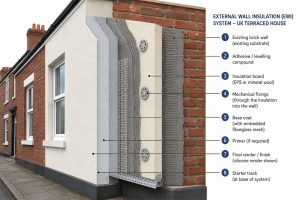
At the base of the system. Where the insulation meets the ground, the base detail must include a starter track, adequate clearance from ground level, and a render stop that prevents water wicking upward into the system.


At the eaves. The junction between the top of the EWI and the soffit or bargeboard requires careful sealing to prevent water from tracking down behind the system.


At penetrations. Pipes, meters, and wall ties that penetrate the EWI system each represent a potential water entry point if not correctly collared and sealed.

Thermal Bridging at Junctions

EWI works by wrapping the building continuously in an insulating layer. Where that continuity breaks, at window reveals, at the base of the wall, at the roofline, thermal bridges remain. A poorly specified installation addresses the wall face but neglects the reveals, leaving cold bridges that continue to lose heat and can cause condensation on the inner face of the wall at those points.


A correctly specified installation insulates into reveals and forms clean junctions at every penetration of the insulated envelope.

Interstitial Condensation in Certain Wall Types

On some wall constructions, particularly those with a plasterboard dry lining already present, adding EWI to the outside can shift the dew point to a location within the wall construction where moisture accumulates. This is more likely where the wall already has multiple layers with different vapour permeability characteristics.


A competent installer surveys the wall construction before specifying the system and identifies whether any vapour control measures are needed.


What Makes an Installation Go Wrong

Most EWI failures trace back to one of three root causes.


Inadequate survey. An installer who quotes without visiting the property, or who visits but does not assess wall condition, substrate pullout strength, exposure rating, and existing defects, is setting up the installation to fail. The survey is where problems are identified and addressed before insulation boards go on.


Cost cutting on materials or labour. EWI installed under competitive grant funding pressure sometimes uses thinner boards, fewer fixings, or faster application than the specification requires. The result looks acceptable initially but fails within a few years.


Poor detailing at junctions. Most failures are detail failures rather than failures of the main insulation layer. An installer who does not have a practiced approach to window reveals, base details, eaves junctions, and penetrations creates vulnerabilities in every installation they complete.


How to Identify EWI Problems on an Existing Installation

If a property already has EWI and you suspect problems, these signs indicate investigation is needed:


Visible cracks in the render. Fine map cracking may be superficial. Cracks at regular intervals that follow the lines of board joints, or cracks at window and door corners, indicate more serious movement or detailing issues.


Damp patches on internal walls. Particularly on elevations facing prevailing rain. Damp that appears after rainfall and correlates with specific external locations suggests water entry through the EWI system.


Cold spots identified by thermal imaging. A thermal imaging survey of the internal walls in cold weather reveals areas where insulation is absent or where thermal bridging is significant. This is the most reliable diagnostic tool for assessing EWI performance.


Staining or biological growth on the render surface. Some staining is normal on exposed render, particularly on north facing elevations. Heavy biological growth can indicate a render surface that retains moisture longer than it should, which may point to a finish coat that has lost its water repellency.


Choosing an Installer to Avoid These Problems

The most reliable protection against EWI failure is installer quality. Look for:


PAS 2030 certification, the quality standard required for publicly funded EWI and the benchmark for technical competence in this sector.


TrustMark registration, the government endorsed quality scheme covering workmanship and complaint resolution.


BBA certification for the specific system, not just for insulation in general, but for the exact system being installed on your property.


A proper pre installation survey, any installer who quotes without visiting the property or who cannot explain how they will detail the window reveals, base, and eaves is not the right choice.


References from similar properties, ask for examples of EWI installed on properties of similar age, construction, and exposure to yours.


Frequently Asked Questions

How long should external wall insulation last? A correctly installed EWI system should last 25 to 40 years. The render finish may need cleaning or minor maintenance over that period but should not require significant remedial work within the first decade.


Can EWI be repaired if it fails? Minor render cracks can be filled and repainted. More significant failures, particularly those involving moisture ingress behind the insulation layer, typically require stripping back the affected section and reinstating it correctly, which is substantially more expensive than getting the installation right first time.


Does EWI always improve an EPC rating? Yes, though the extent of improvement depends on how much exposed wall the property has. A detached property with four external elevations sees a larger EPC improvement than a mid terrace with only front and rear elevations. The improvement also depends on what other measures are present, loft insulation, glazing and heating all affect the overall score.


Is cracking in EWI always a sign of failure? Not necessarily. Hairline shrinkage cracks in the first year after installation are common and generally superficial. Cracks that widen, cracks at board joints, or cracks that are accompanied by internal damp are more serious and warrant investigation.

Look at some of our real projects here.

external wall insulation problemsInformation and data references correct as of April 2026. If you suspect EWI failure on an existing installation, commission a thermal imaging survey from a qualified assessor before deciding on remedial action.


External Solid Wall Insulation for Solid Brick Semi-Detached Houses

If you own a solid brick semi-detached house, you already know it runs cold; you may need to check your external solid wall insulation. Solid brick walls lose heat at roughly seven times the rate of a well-insulated cavity wall, and no amount of draught proofing or boiler upgrades fully compensates for that. External wall insulation (EWI) is the most effective fix, and for solid brick semis specifically, it delivers results that internal insulation simply cannot match.


Why Solid Brick Semis Are Different

Most semi-detached houses built before 1920 use solid brick construction: two leaves of brick laid together with no gap between them. The wall is typically 225mm thick, one brick length, and transfers heat directly from the warm interior to the cold outside.


You can usually identify solid brick construction by looking at the bond pattern. Alternate rows of headers (bricks laid end-on) and stretchers (bricks laid lengthways) indicate solid construction. If every row shows only the long face of the brick, you likely have a cavity wall built after the 1930s.


Solid brick semis present a specific set of challenges that make EWI the preferred solution:


No cavity to fill. The only two options for improving wall thermal performance are external or internal insulation. There is no cavity to inject material into.


Shared wall with the neighbour. The party wall between the two halves of the semi is not an external wall and does not need insulating. EWI wraps the three external faces of your half of the building: front, rear, and the exposed side gable.


Heat loss through junctions. In solid brick construction, the floor, ceiling, and partition wall junctions all connect directly to the cold outer wall, creating thermal bridges. EWI eliminates these bridges by wrapping the entire external envelope. Internal wall insulation treats only the wall surface and leaves bridges at every junction.


How EWI Works on a Solid Brick Semi

The installation sequence for a solid brick semi-detached house follows the same core steps as any EWI project, with a few details specific to this property type.


  1. Survey and preparation The installer surveys the existing brickwork for damage, loose render, or signs of damp. Any issues need resolving before insulation goes on. The survey also checks pullout strength of the fixings into the brick substrate, which varies depending on brick quality and mortar condition.


  1. Insulation boards fixed to the three external faces Boards fix to the front elevation, rear elevation, and the side gable. The installer staggers the joints in a brick bond pattern to prevent cold bridging through the board joints. Around windows, doors, and the eaves, the boards need careful cutting and detailing.


  1. Window and door reveals This is one of the trickier details on a semi. Adding 80 to 120mm of insulation to the outside of the wall brings the external face forward, deepening window and door reveals. The installer fits insulation into the reveals and makes good the junctions. In some cases this requires extending window sills outward.


  1. Junction with the party wall Where your external wall meets the party wall at the side of the house, the installer needs to form a clean, weathertight junction. This edge requires careful detailing with appropriate stop beads and sealants.


  1. Base coat, mesh, and finish A glass fibre reinforcing mesh embeds in the base coat render, followed by a primer and the chosen finish coat, typically silicone render for durability on a semi-detached house exposed to weather on three sides.


Which Solid Wall Insulation System Works Best for Solid Brick?

Three main systems suit solid brick semi-detached houses.

EPS (Expanded Polystyrene)

The most widely used system. EPS boards are cost effective, widely available, and perform well thermally. An 80 to 100mm EPS board achieves a U-value of around 0.30 W/m²K on a solid brick wall, compared to the uninsulated starting point of approximately 2.10 W/m²K. For most solid brick semis in non-conservation areas, EPS is the right choice.

Mineral Wool

A non-combustible option required on buildings over 11 metres in height. For a typical two-storey semi-detached house this is rarely a regulatory requirement, but some homeowners choose mineral wool for its fire performance and acoustic properties. It costs more than EPS and requires more careful handling on site.

Woodfibre

A breathable, vapour-open system increasingly recommended for older solid brick properties where moisture management matters. Solid brick walls rely on their mass to buffer moisture, trapping vapour with a non-breathable system can lead to problems. Woodfibre is more expensive but handles the moisture dynamics of solid brick better than synthetic boards in some situations.


A good installer will discuss which system suits your specific property before quoting.


What Does Solid Wall Insulation Cost on a Solid Brick Semi?

A typical solid brick semi-detached house with three external elevations to insulate falls in the following cost range in 2026:


Property size Estimated cost
Two-bedroom semi (approx. 70m² floor area) £8,000 to £11,000
Three-bedroom semi (approx. 90m² floor area) £10,000 to £14,000
Larger semi or extended property £13,000 to £18,000


These figures cover a standard EPS system with silicone render, scaffolding, and making good around openings. Factors that push costs higher include complex rooflines, bay windows, poor existing render that needs stripping first, or a conservation area finish requirement.


Grants for Solid Wall Insulation for Brick Semis

Solid brick semi-detached houses frequently qualify for grant funding because they sit at the lower end of the EPC scale. An uninsulated solid brick semi typically rates E or F, exactly the profile that ECO4 and the Great British Insulation Scheme target.

ECO4

Energy company obligation funding covers EWI for low income and fuel poor households. Solid brick semis with EPC ratings of E, F, or G are strong candidates. Both owner occupiers and private tenants can apply. There is no strict income threshold, eligibility depends on a combination of property EPC rating, household circumstances, and the installer’s assessment.

Great British Insulation Scheme (GBIS)

Targets properties in council tax bands A to D or with EPC ratings of D or below. A solid brick semi rated E or F almost always qualifies. The scheme funds one primary measure per property, EWI qualifies as a primary measure.

Local Authority Schemes

Some local authorities run area-based programmes targeting streets of solid brick terraces and semis. These can deliver fully funded EWI where the whole street participates, which also reduces individual installation costs through economies of scale.


Contact a TrustMark-registered, PAS 2030-certified installer to run an eligibility check. Many homeowners with solid brick semis qualify for fully or heavily subsidised installation.


Does EWI Affect the Appearance of a Solid Brick Semi?

Yes, and this is worth thinking through before committing. Adding insulation and render to the outside of a solid brick semi changes how it looks. The brickwork disappears behind the render finish, and the building gains a rendered appearance.


For most solid brick semis on standard residential streets this is not a problem, and silicone render in a brick-red or cream tone can look clean and well-maintained. However, there are situations where appearance matters more:


Conservation areas: If your semi sits in a conservation area, the local planning authority may require a specific finish that respects the character of the area, sometimes brick slips rather than render, which costs more.


Listed buildings: EWI is generally not appropriate for listed buildings without specific consent. Internal insulation is more common in this context.


The neighbour: Only your half of the semi gets insulated. If your neighbour does not insulate at the same time, the two halves will look different. Many homeowners approach their neighbour before starting, both to discuss aesthetics and because doing both halves simultaneously reduces scaffold costs.


EWI vs Internal Wall Insulation for a Solid Brick Semi

Some homeowners consider internal wall insulation (IWI) as an alternative, usually because they want to preserve the external brickwork. Here is an honest comparison for a solid brick semi specifically.


Factor EWI IWI
Thermal performance Eliminates all thermal bridges Leaves bridges at floor, ceiling, and partition junctions
Floor area lost None 75 to 100mm per treated wall, significant in a semi
Disruption External works only Every room needs stripping back: skirting, radiators, sockets, window reveals
External appearance Changes to rendered finish Preserves brickwork
Party wall No treatment needed May need treating at junction
Cost Higher upfront Lower upfront but greater disruption cost


For most solid brick semis, EWI delivers better thermal performance with less internal disruption. IWI makes more sense when planning constraints prevent external works, or when the homeowner is already doing a major internal renovation and can absorb the disruption.


Frequently Asked Questions

Do I need planning permission for solid wall insulation on a semi-detached house?

Usually not. EWI falls under permitted development for houses in England. You need planning permission if you are in a conservation area and the proposed finish does not comply with local requirements, or if your permitted development rights have been removed. Always check with your local authority if you are unsure.


Can I insulate just the front or rear of my semi?

Technically yes, but it is not recommended. Insulating only part of the external envelope creates new thermal bridges at the junctions between insulated and uninsulated sections. The installer also needs to form a weathertight edge detail at those junctions. Whole-house EWI delivers the full benefit and avoids these complications.


What happens at the roofline?

The installer needs to detail the junction between the top of the insulation and the eaves carefully. On a typical semi this involves either cutting into the soffit slightly or using a purpose-made eaves closure system. A good installer handles this as standard.


How long does installation take on a solid brick semi?

Typically 10 to 20 working days depending on property size, weather, and the complexity of the detailing around openings and junctions. The scaffolding goes up first and comes down last.


Will external solid wall insulation affect my neighbour?

EWI sits entirely on your property and does not affect the party wall or your neighbour’s half of the building. You should notify your neighbour before work begins as a courtesy and to manage expectations about scaffold access and any minor disruption. If their half of the semi is uninsulated, consider whether you can approach them about doing both at once.

External solid wall insulation

Find out more about us and how we can help.

External Wall Insulation Cost UK 2026 Guide (Per m² + Full Prices)

External wall insulation cost in the UK typically ranges from £90 to £150 per m² in 2026, with most homeowners paying between £8,000 and £22,000 depending on property size, materials, and installation complexity. Understanding external wall insulation cost is essential if you’re planning to improve your home’s energy efficiency and reduce heating bills.


What Is External Wall Insulation and Why It Matters

External wall insulation is a system where insulation boards are fixed to the outside of your home and finished with render to improve energy efficiency and reduce heat loss.

How external wall insulation works

Insulation boards such as EPS, mineral wool, or phenolic foam are attached to external walls, then covered with render to create a thermal barrier that reduces heat escaping.

Benefits for energy efficiency, comfort, and home value

  • Reduces heat loss by up to 35%
  • Lowers energy bills
  • Improves indoor comfort
  • Increases EPC rating
  • Enhances kerb appeal

Why UK homeowners are investing in insulation in 2026

With rising energy costs and stricter EPC requirements, insulation is becoming a priority upgrade for long-term savings and compliance.


External Wall Insulation Cost in the UK

External wall insulation in the UK costs between £90 and £150 per m², depending on materials, labour, and property type.

Average cost per m² in 2026

  • £90–£150 per m² installed
  • Premium systems can exceed £180 per m²

Total installation cost by property type

  • Flat / Apartment: £6,000 – £12,000
  • Terraced house: £8,000 – £15,000
  • Semi-detached: £10,000 – £18,000
  • Detached house: £15,000 – £25,000+

Example: cost breakdown for a 3-bedroom semi-detached home

A typical semi-detached property with 100–120 m² of wall area will cost around £11,000–£14,000 depending on insulation type and finish.


What Affects the Cost of External Wall Insulation?

Several factors influence the total cost of external wall insulation, from materials to labour and property characteristics.

Size of your home and total wall area

Larger properties require more materials and labour, increasing total cost.

Type of insulation material

  • EPS: most affordable
  • Mineral wool: mid-range
  • Phenolic foam: premium

Thickness of insulation and U-value requirements

Thicker insulation improves performance but increases cost.

Labour, scaffolding, and finishing

Scaffolding and render finishes can add £1,000–£3,000 or more to the total project.

Location and installer pricing differences

Prices vary across the UK, with London and the South East typically more expensive.


External Wall Insulation Cost Comparison: With vs Without Grants

External wall insulation costs can be significantly reduced through UK government schemes and energy grants.

Typical full price (without grants)

Most homeowners pay between £10,000 and £20,000 without financial support.

Reduced cost after ECO4, GBIS, or local schemes

Grants can reduce costs to £0–£5,000 depending on eligibility.

How to check eligibility for insulation grants

Eligibility depends on income, EPC rating, and property type.

Grant calculator

Check your eligibility and estimated savings using our external wall insulation grant calculator.


Long-Term Savings and Payback Period

External wall insulation can deliver significant savings over time through reduced energy consumption.

How much can you save on energy bills each year

Most households save between £300 and £700 annually.

Average payback time (with and without grant)

  • Without grants: 12–20 years
  • With grants: 3–8 years

Carbon footprint and EPC rating improvements

External insulation improves EPC ratings and reduces carbon emissions.


Hidden Costs to Be Aware Of

There are additional costs to consider beyond installation.

Planning permission and building regulation costs

Planning permission may be required for listed or protected properties.

Extra costs for repairs or wall preparation

Pre-installation repairs such as damp treatment can increase costs.

Maintenance and lifespan of external wall insulation

Systems typically last 25–40 years with minimal maintenance.


How to Reduce the Cost of External Wall Insulation

There are several ways to make external wall insulation more affordable.

Apply for insulation grants and local council schemes

Government funding can significantly reduce installation costs.

Combine with other energy-saving upgrades

Bundling projects like window replacement can reduce overall costs.

Choose the right installer and get multiple quotes

Comparing quotes helps ensure competitive pricing.


Cost Comparison: External vs Internal Wall Insulation

External and internal insulation differ in cost, performance, and disruption.

Key differences in price, performance, and disruption

External insulation is more expensive but more effective and less disruptive internally.

When internal insulation might be more cost-effective

Internal insulation may suit lower budgets or restricted properties.

Which is best for your property type

External insulation is generally better for solid wall homes.


FAQs About External Wall Insulation Costs

What’s the cheapest insulation material?

Expanded polystyrene (EPS) is typically the most affordable.

Does insulation add value to your home?

Yes, improved EPC ratings can increase property value.

Can I install external wall insulation myself?

Professional installation is recommended due to complexity.

How long does installation take?

Most projects take 1–3 weeks depending on size.


Is External Wall Insulation Worth the Cost in 2026?

External wall insulation is worth the cost for many UK homeowners due to energy savings, improved comfort, and long-term value.

Quick cost vs benefit summary

  • High upfront cost
  • Strong long-term savings
  • Improved efficiency

When grants make it worthwhile

Grants can reduce costs dramatically, making insulation highly cost-effective.

Next steps

Get a quote or check your eligibility for grants to start improving your home’s energy efficiency.

Average External Wall Insulation Cost Summary

External wall insulation cost in the UK ranges from £8,000 to £22,000 depending on property size, materials, and eligibility for grants.

External Wall Insulation Grants UK: The Complete 2026 Guide

Covers: ECO4, Warm Homes: Local Grant, Warm Homes: Social Housing Fund, devolved nation schemes, and what to do if you don’t qualify

Solid walls are responsible for up to 35% of heat loss in a typical UK home. For the 7.7 million solid-wall properties in England and Wales alone, external wall insulation (EWI) is one of the most impactful upgrades available, but it’s also one of the most expensive, typically costing between £8,000 and £25,000 depending on the size and complexity of the property.

The good news is that government-backed grants can cover a significant portion or sometimes the entire cost for qualifying households. This guide explains every scheme currently available in the UK, who is eligible, how much you can receive, and exactly how to apply.

ℹ️ Quick answer: If you receive means-tested benefits (such as Universal Credit or Pension Credit) or have a household income under £36,000 and an EPC rating of D to G, you are very likely to qualify for free or heavily subsidised external wall insulation. Read on to find out which scheme applies to you.

UK external wall insulation grant schemes at a glance

Here is a summary of the main schemes currently available. Each is explained in full below.

Scheme

Who it’s for

Max support

Deadline

ECO4

Low-income households on qualifying benefits; EPC D–G

Up to 100% of costs

March 2026

Warm Homes: Local Grant

Low-income homeowners & private tenants; EPC D–G

Up to £15,000 (energy efficiency)

2025–2028

Warm Homes: Social Housing Fund

Social housing tenants; EPC D–G

Varies by provider

Ongoing

Warmer Homes Scotland

Low-income homeowners & tenants in Scotland

Up to 100% of costs

Ongoing

Nest (Wales)

Homeowners & tenants in Wales on low income

Free improvements for eligible

Ongoing

Affordable Warmth (NI)

Households earning under £24,750 in Northern Ireland

Free improvements for eligible

Ongoing

1. Energy Company Obligation 4 (ECO4)

ECO4 is the UK’s largest energy efficiency scheme, running from April 2022 to March 2026 with a total value of £4 billion. It places a legal obligation on medium and large energy suppliers including British Gas, E.ON, Octopus, and EDF to fund energy-saving improvements in eligible properties. External wall insulation is one of the measures covered.

Unlike some schemes that fund a single improvement, ECO4 takes a whole-house approach. This means multiple measures such as insulation, heating upgrades, heat pumps, and more can be installed in one project, aiming to bring your home up to at least an EPC C rating where feasible.

Who qualifies for ECO4?

You must live in private housing (owner-occupied or privately rented) or social housing. For private housing, you’ll need to be receiving at least one of these benefits:

  • Universal Credit
  • Pension Guarantee Credit or Pension Savings Credit
  • Income Support
  • Income-based Jobseeker’s Allowance
  • Income-related Employment and Support Allowance
  • Child Benefit (subject to income limits)
  • Housing Benefit
  • Tax Credits (Child Tax Credit or Working Tax Credit)

Additionally:

  • Owner-occupied homes must have an EPC rating of D, E, F, or G.
  • Private rental properties must have an EPC rating of E, F, or G (and require landlord permission).
  • Social housing must have an EPC rating of E, F, or G.

💡 ECO Flex: Even if you don’t receive the benefits listed above, your local council can refer you under ‘flexible eligibility’ if your household income is low, you have a health condition worsened by cold, or you’re experiencing persistent fuel debt or are unable to top up a prepayment meter. Contact your local authority to ask about an ECO Flex referral.

What does ECO4 cover?

ECO4 covers a wide range of measures, not just insulation:

  • External and internal solid wall insulation
  • Cavity wall insulation
  • Loft, underfloor, and roof insulation
  • Boiler upgrades and replacements
  • First-time central heating installation
  • Air source heat pumps
  • Solar panels (in certain circumstances, e.g. when paired with a heat pump)
  • Smart heating controls

How much will ECO4 cover?

Costs are fully covered for many eligible households. However, for higher-value measures like solid wall insulation or heat pumps, some households may be asked to contribute a top-up payment. The level of support varies by energy supplier and project scope. Always request itemised quotes from at least three TrustMark-accredited installers and compare what each supplier is offering before agreeing to any work.

How to apply for ECO4

  1. Check whether you receive a qualifying benefit (listed above).
  2. Contact any participating energy supplier, you do not need to use your own supplier.
  3. They will arrange a free home assessment to confirm eligibility and identify suitable measures.
  4. If approved, an accredited installer will carry out the work. You do not pay upfront.

Alternatively you can request a quote on homepage at Eco Insulation

⚠️ Important: ECO4 is scheduled to end in March 2026. If you think you might qualify, apply as early as possible — funding is finite and energy suppliers prioritise applications that are easiest for them to meet their targets.

2. Warm Homes: Local Grant

The Warm Homes: Local Grant (WHLG) replaced the Home Upgrade Grant (HUG) scheme in April 2025. It is administered by local councils across England and backed by a £500 million government budget running from 2025 to 2028. This makes it one of the most important new funding routes for external wall insulation in the coming years.

Unlike ECO4, which is delivered through energy suppliers, the Warm Homes: Local Grant is managed by your local authority. This means application processes and timelines can vary slightly depending on where you live in England.

Who qualifies for the Warm Homes: Local Grant?

To be eligible, you must:

  • Be a homeowner or a private tenant (with your landlord’s agreement).
  • Have a gross household income of £36,000 or less per year.
  • Live in a property with an EPC rating of D, E, F, or G.
  • Live in England (separate schemes apply in Scotland, Wales, and Northern Ireland — see below).

You may also qualify if you receive any of the following means-tested benefits, regardless of income:

  • Universal Credit
  • Pension Credit
  • Housing Benefit
  • Income-based Jobseeker’s Allowance
  • Income-related Employment and Support Allowance
  • Child Tax Credit or Working Tax Credit

In some cases, local authorities may also be able to refer households in pre-qualified postcodes, even if the above criteria are not met. Check with your local council directly.

What does the Warm Homes: Local Grant cover?

The scheme provides two streams of funding:

  • Up to £15,000 per property for energy efficiency improvements, including external wall insulation, draught-proofing, new windows and doors, loft insulation, and underfloor insulation.
  • Up to an additional £15,000 for low-carbon heating systems, such as air or ground source heat pumps. This is particularly relevant for homes not connected to the gas grid.

💡 Key point: The total potential support is up to £30,000 per household when combining energy efficiency and heating upgrades. For a typical external wall insulation project, the energy efficiency fund alone may cover the entire cost for qualifying properties.

How to apply for the Warm Homes: Local Grant

  1. Visit your local council’s website and search for ‘Warm Homes Local Grant’ or ‘energy efficiency grants’.
  2. Complete an eligibility check — most councils have an online form or a phone line.
  3. If eligible, a council-approved assessor will visit your home to evaluate what improvements are needed.
  4. Approved works are carried out by TrustMark-accredited installers appointed through the scheme.

3. Warm Homes: Social Housing Fund

If you live in social housing (council or housing association), your landlord may be eligible for funding through the Warm Homes: Social Housing Fund, which replaces the Social Housing Decarbonisation Fund.

This scheme funds energy efficiency improvements, including external wall insulation for social housing properties with an EPC rating of D or below. The fund is available to social landlords, not directly to tenants, so the application is your landlord’s responsibility.

If you are a social housing tenant and your property is poorly insulated, contact your housing association or council housing team directly and ask whether they are participating in the Warm Homes: Social Housing Fund. You cannot apply as an individual, but raising the issue often accelerates action.

4. Devolved nation schemes: Scotland, Wales, and Northern Ireland

England’s schemes do not apply in Scotland, Wales, and Northern Ireland, which each have their own grant programmes. Here is a summary of the main routes for external wall insulation funding in each nation.

Scotland: Warmer Homes Scotland

Warmer Homes Scotland is a government-funded scheme for low-income and vulnerable households. It can cover up to 100% of the costs of energy efficiency improvements, including external wall insulation, and offers a zero-interest loan where a contribution is required.

To qualify, you must be a homeowner or a private-sector tenant, live in a home that meets the Housing (Scotland) Act 2006 standard, and meet at least one of the following:

  • Be of pensionable age with no working heating system and receive a passport benefit
  • Be aged 75 or older and eligible for a passport benefit
  • Have a child under 16, be pregnant, and receive a passport benefit
  • Receive Personal Independence Payment (PIP) or a high-rate Disability Living Allowance

Apply through Home Energy Scotland: 0808 808 2282.

Wales: Nest scheme

The Nest scheme is the Welsh Government’s energy efficiency programme. It offers free insulation and other home improvements to homeowners and private tenants on a low income or receiving qualifying benefits, and to those with health conditions that are worsened by cold or damp.

Apply through the Energy Saving Trust Wales: 0808 808 2244.

Northern Ireland: Affordable Warmth Scheme

The Affordable Warmth Scheme in Northern Ireland provides home improvement grants for households with a gross annual income under £24,750. Works can include insulation, heating systems, and other energy-saving measures.

Contact your local council in Northern Ireland or the Northern Ireland Housing Executive (NIHE) to apply.

5. Quick eligibility checker: which scheme applies to you?

Use this table to identify the most likely grant route based on your circumstances. Always confirm eligibility directly with the relevant scheme before applying.

Question

If YES

If NO

Do you receive Universal Credit, Pension Credit, or another means-tested benefit?

You are very likely eligible for ECO4. Contact any major energy supplier.

Move to the next question.

Is your household income under £36,000 per year and your EPC rating D–G?

Apply for the Warm Homes: Local Grant through your local council (England only).

Move to the next question.

Do you live in social housing with an EPC rating of D or below?

Ask your housing association or council about the Warm Homes: Social Housing Fund.

Move to the next question.

Do you live in Scotland?

Contact Home Energy Scotland for the Warmer Homes Scotland scheme.

Do you live in Wales?

Contact the Nest scheme for Welsh Government support.

Do you live in Northern Ireland with income under £24,750?

Apply through the Affordable Warmth Scheme via your local council.

See ‘What if I don’t qualify?’ below.

6. What if I don’t qualify for a grant?

If none of the above schemes apply to your situation, there are still options to make external wall insulation more affordable.

VAT reduction

External wall insulation installed on existing residential properties qualifies for a reduced VAT rate of 0% (reduced from 20% in April 2022). This saving alone can be worth £1,500–£4,000 on a typical project.

0% VAT on energy-saving materials

The 0% VAT relief applies to a range of energy-saving materials when supplied and installed by a VAT-registered contractor. Make sure your installer is VAT-registered and confirms this rate applies.

Pay in instalments

Many reputable installers, including Eco Insulation, offer staged payment terms. Some also work with third-party finance providers offering low-interest or 0% finance for home improvement projects.

Local council grants and flexible eligibility

Even if you don’t meet the standard criteria, it is worth contacting your local council directly. Many councils have discretionary funds or can refer you under ECO Flex if you are considered vulnerable or in fuel poverty by other measures.

Energy company trust funds

Several major energy suppliers including British Gas, E.ON, and EDF, run charitable trust funds for customers in financial difficulty. These can sometimes be used alongside other funding to cover the cost of insulation.

7. How to apply: a step-by-step guide

Whichever scheme you are applying for, the process follows a similar pattern:

  1. Check your EPC rating. You can find this for free at the government’s EPC register at epcregister.com. If your property has no current EPC or the rating is out of date, a new assessment costs around £60–£120 and is often worth commissioning before applying.
  2. Confirm your benefits or income status. Have proof of any qualifying benefits or your household income ready before contacting a scheme.
  3. Contact the scheme or an installer. For ECO4, contact any participating energy supplier. For the Warm Homes: Local Grant, contact your local council. For Eco Insulation, we can assess your eligibility and point you in the right direction as part of our free quote process.
  4. Home assessment. A qualified assessor will visit your property to confirm suitability and scope the works.
  5. Installer survey and quote. If grant funding is confirmed, you will receive a detailed quote. If a household contribution is required, this will be specified clearly at this stage.
  6. Installation. Work is carried out by TrustMark and PAS 2030-accredited installers. This typically takes one to three weeks for a standard residential property, depending on size and access.
  7. Updated EPC and documentation. Once work is complete, request an updated EPC certificate and retain all warranty and certification documents.

8. Avoiding scams and poor-quality work

⚠️ Warning: Grant-funded insulation schemes attract a significant number of rogue traders and poor-quality installers. Follow these steps to protect yourself.

  • Only use TrustMark-accredited installers. TrustMark is a government-backed quality scheme. You can check any installer’s credentials at trustmark.org.uk.
  • All work funded under ECO4 or Warm Homes schemes must comply with PAS 2030 and PAS 2035 retrofit standards. Ask your installer to confirm this in writing before agreeing to any work.
  • Never pay cash upfront. Legitimate grant-funded schemes do not require upfront payment from homeowners.
  • Be wary of cold callers claiming you are ‘automatically eligible’ for free insulation. Eligibility must be formally assessed by a qualified retrofit assessor.
  • Get at least three quotes. Even if you are receiving grant funding, compare installers on the quality of materials, warranty terms, and the detail of their specification and not just on headline price.
  • Check that your installer will provide a 25-year insurance-backed guarantee (IBG) on the work through a scheme such as SWIGA or CIGA.

9. Frequently asked questions

Can I get a grant if I own my home outright?

Yes. Homeownership status does not affect eligibility for ECO4 or Warm Homes grants. What matters is your income, benefit status, and EPC rating.

Can tenants apply for external wall insulation grants?

Yes, but you will need your landlord’s written permission before any work can begin. Some schemes, including ECO4, can also fund improvements to rental properties if the landlord applies directly.

My home is a listed building or in a conservation area. Can I still get EWI?

Listed buildings and properties in conservation areas may require planning permission before external wall insulation can be installed. In some cases, internal wall insulation may be a more appropriate alternative. Speak to your local planning authority and a specialist retrofit assessor before proceeding.

How long does external wall insulation last?

A properly installed EWI system should last 25 to 40 years with minimal maintenance. The render finish may require cleaning or touching up over time. A 25-year insurance-backed guarantee from a reputable scheme provides important long-term protection.

Will external wall insulation affect my home’s appearance?

EWI adds a few centimetres to the thickness of your external walls, which can actually improve your home’s appearance when finished with modern silicone render, brick slips, or other decorative finishes. Before and after images of real projects are available on the Eco Insulation website.

Can I combine external wall insulation with other improvements under the same grant?

Under ECO4, yes! Multiple measures can be installed in a single project. Under the Warm Homes: Local Grant, EWI can be combined with other energy efficiency improvements up to the £15,000 energy efficiency cap. GBIS generally covers only one measure, though this changed in May 2025 when two measures became available under certain conditions.

What happens after the grant schemes end?

ECO4 and GBIS are both scheduled to end in March 2026. The Warm Homes: Local Grant runs to 2028. The government has signalled ongoing commitment to the Warm Homes Plan as part of its Net Zero 2050 target. New schemes are expected to follow. Eco Insulation will update this guide as new information becomes available.

Find out if you qualify and get a free quote with ECO Insulation

Eco Insulation works with homeowners and tenants across England and Wales. As part of our free, no-obligation quote process, we will assess which grant schemes you may be eligible for and connect you with the right funding route. Our aim is to provide you with the best external wall wnsulation grants, information and providers.


All Eco Insulation work is carried out by TrustMark-accredited installers and backed by a 25-year insurance-backed guarantee.

Last updated: March 2025. This guide is reviewed regularly to reflect changes to government schemes. Always verify eligibility directly with the relevant scheme before applying.

Why External Wall Insulation Is So Important in the UK

External wall insulation is becoming increasingly important in the UK as the country faces rising energy costs, ageing housing stock, and ambitious climate targets. Many homes across the UK were built before modern insulation standards existed, which means they lose heat quickly and require more energy to stay warm. External wall insulation offers an effective solution that improves comfort, reduces bills, and supports long term environmental goals.

UK Climate

One of the main reasons external wall insulation matters in the UK is the climate. The UK leans to the colder side and experiences long periods of cold and damp weather, especially during autumn and winter. Homes without adequate insulation allow heat to escape through the walls, making rooms feel cold and uncomfortable. By adding insulation to the outside of a building, heat is retained inside for longer, helping households maintain a stable indoor temperature without constantly relying on heating systems.

Energy efficiency

Energy efficiency is another major benefit. Heating accounts for a large portion of household energy use in the UK. When walls are poorly insulated, more energy is needed to compensate for heat loss. It’s also counter-productive and inefficient to heat a home where heat escapes. External wall insulation significantly reduces this loss, meaning boilers and heating systems do not have to work as hard. As a result, households can see noticeable reductions in their energy bills, which is particularly important during times of high fuel prices.

Fuel Poverty

External wall insulation also plays a key role in tackling fuel poverty. Many UK households struggle to afford adequate heating, often living in older properties with solid walls that are difficult to insulate internally. External insulation improves thermal performance without reducing internal living space, making it an effective option for vulnerable households. Warmer homes can lead to better health outcomes by reducing damp, mould, and cold related illnesses.

Climate Targets

From an environmental perspective, external wall insulation supports the UK commitment to reducing carbon emissions. Homes that require less energy for heating produce fewer emissions overall. As the UK moves toward cleaner energy and sustainability targets, improving the efficiency of existing buildings is just as important as developing new technologies. External wall insulation helps bridge this gap by upgrading older homes to modern standards.

Aesthetics

There are also aesthetic and protective advantages. External wall insulation often includes a new outer finish, which can improve the appearance of a property and refresh tired or weathered facades. At the same time, it adds a layer of protection against rain and temperature changes, helping to reduce cracks and long term structural damage caused by exposure to the elements.

A general upgrade

In conclusion, external wall insulation is vital in the UK due to the climate, the age of the housing stock, and the need to reduce energy use and emissions. It delivers warmer homes, lower energy bills, improved health, and environmental benefits. As the UK continues to face economic and environmental challenges, external wall insulation stands out as a practical and valuable investment for the future.

Find out all you need to know on external wall insulations with Eco Insulation

External wall insulation examples: Real projects that show what is possible

If you are researching external wall insulation examples to see how the upgrade could work for your own home, it helps to look at real projects and understand what different systems can achieve. External wall insulation adds an insulating and protective layer to the outside of your property, reducing heat loss, improving comfort, and renewing the appearance of the building. With more than eight million solid wall homes in the UK still uninsulated, the potential for improvement is substantial.

Below, we explore clear examples of how external wall insulation works across different homes, finishes, and retrofit goals.

What external wall insulation is and how it works

External wall insulation is a system in which insulation boards are fixed to the exterior of your house and covered with a protective finish such as render, brick slips, or cladding. This approach improves thermal performance without reducing internal space and can dramatically cut heat loss through solid or poorly insulated walls.

External wall insulation examples for different property types

Victorian and Edwardian solid wall houses 

External wall insulation is particularly effective for Victorian and Edwardian homes with solid brick walls that lose heat quickly. Installers fix insulation boards directly to the masonry and apply either render or brick slips, allowing you to retain a traditional appearance or choose a more modern look. Upgrading these walls can reduce heat loss significantly and help prevent cold internal surfaces and condensation.

1930s semis and mid-century homes External wall insulation examples 

External wall insulation works well for 1930s and mid-century houses that have cavity walls but little or no insulation. When cavity insulation is unsuitable or insufficient, insulation boards can be added to the exterior and finished with coloured render. This creates a cleaner, uniform façade while improving thermal performance. 

Bungalows 

Bungalows often have more exposed wall area relative to their floor area, which means external wall insulation can have a noticeable impact on comfort and warmth. Adding insulation and a render or cladding finish helps stabilise temperatures throughout the home and can be especially effective when paired with upgraded loft insulation.

External wall insulation examplesFlats and apartment blocks 

External wall insulation is commonly used on both low-rise and high-rise blocks because it can be installed from the outside with minimal disruption to residents. The system is applied over existing façades and finished with modern render or cladding. This improves thermal performance across the building and can reduce heating demand for communal systems.

External wall insulation examples based on different finishes

Render finishes 

Render is one of the most popular finishes for external wall insulation. It comes in smooth, textured, or silicone-enhanced options and a wide choice of colours. Render is low maintenance, suitable for most property types, and often chosen when homeowners want a clean, modern finish.

Brick slips 

Brick slips are thin brick tiles fixed over the insulation to replicate traditional brickwork. They are ideal where planning rules or personal preference require a brick appearance. With many colours and textures available, they allow you to improve efficiency while keeping the character of a brick façade.

Timber-effect or composite cladding 

Timber-effect or composite panels can be fitted over insulation to create a contemporary look. These products are engineered for weather resistance and low maintenance and are often combined with render to introduce contrast or break up larger elevations.

Stone-effect panels 

Stone-effect panels provide the appearance of natural stone in a lighter, easier-to-install format. They are suitable for cottages, rural properties, or homes where a textured, high-quality exterior is desired.

External wall insulation examples that solve common problems

Reducing cold internal walls 

Wrapping a property in external insulation raises internal wall temperatures. It can help your home feel warmer and lower the likelihood of condensation and mould.

Eliminating draughts and cold spots 

External insulation helps to close small gaps in older masonry and creates a continuous thermal layer. This reduces draughts and minimises cold spots around junctions and window reveals.

Improving EPC ratings 

External wall insulation examplesUpgrading wall insulation can significantly improve a property’s EPC rating because walls are one of the largest sources of heat loss. Better ratings can benefit homeowners, landlords, and future resale value.

Modernising tired exteriors

If your home has cracked render, faded paint, or uneven walls, external wall insulation provides an opportunity to correct defects and achieve a refreshed, modern finish.

What to consider before installing external wall insulation

Thickness and appearance 

External wall insulation usually adds between 60 mm and 200 mm to the outside of the wall, depending on the insulation type and the target U-value. Installers will advise on how window reveals, sills, and eaves should be adjusted to maintain a consistent, attractive appearance.

Planning permission 

Most homes do not require planning permission for external wall insulation, although it is needed for listed buildings, conservation areas, or where the appearance changes significantly. An experienced installer will help clarify any local requirements.

Cost and timescale 

Costs vary depending on property size, insulation material, and chosen finish. Most homes are completed within one to three weeks, and installations can be carried out throughout the year.

Pulling it all together: choosing the right external wall insulation system

The best external wall insulation system for your home depends on your wall construction, target energy performance, and the finish you want to achieve. Whether you prefer a smooth render, a traditional brick appearance, or a contemporary cladding style, some options will improve comfort, reduce energy loss, and enhance kerb appeal.

Ready to explore external wall insulation for your home?

If you want to see how external wall insulation could transform your property or you are ready to plan your own upgrade, we are here to help at ecoinsulation.co.uk. Connect with trusted installers and book a quote for a warmer, more efficient, and better-looking home.

External wall tiles and insulation

If you want a home upgrade that delivers both energy savings and a fresh new exterior, combining external wall insulation with external wall tiles is an excellent option. External wall tiles create a durable decorative finish. Meanwhile, the insulation behind them helps keep warmth inside and energy bills under control, which is especially useful for older solid-walled homes.

What are external wall tiles?

External wall tiles are weather-resistant cladding materials fixed to the outside of your property to protect and decorate the walls. They are typically made from porcelain, ceramic, fibre-cement or stone-effect composites designed to withstand rain, frost and sunlight. Once installed, they form a protective outer layer and can give your home either a crisp contemporary look or a more traditional finish.

Why combine external wall tiles with insulation?

Combining external wall tiles with insulation gives you two key benefits:

  1. The insulation reduces heat loss and improves indoor comfort. 
  2. The tiles provide a long-lasting, low-maintenance surface that protects the building structure. 

External wall tilesFor homes with solid walls, which commonly lose more heat than modern cavity walls, this pairing can make a noticeable difference to warmth, energy costs and overall appearance.

When insulation sits behind the tile finish, it slows heat transfer through the walls and creates more stable indoor temperatures. The tiles then act as a strong outer layer that shields the insulation and the wall beneath from wind-driven rain and day-to-day weather.

Which insulation and tile systems work well together?

Several systems allow external wall tiles and insulation to work effectively as one durable upgrade.

Rigid board insulation with ventilated cladding

Rigid insulation boards such as PIR or EPS can be fixed to the outside of the wall and finished with ventilated tile cladding. A ventilated cavity behind the tiles helps manage moisture and allows airflow, while the insulation layer improves thermal performance. This type of rainscreen build-up is common in both refurbishment and new-build projects.

Insulated render base with tile overcladding

Some systems start with an insulated render base using boards, reinforcing mesh and a base coat. Tile cladding is then fixed to the system using rails or approved external adhesives. This approach works with a wide range of tile styles, from sleek porcelain to textured stone-effect designs, while maintaining a consistent insulated layer around the home.

Breathable insulation with ventilated, breathable cladding

Older buildings sometimes need breathable construction. In these cases, mineral wool or wood fibre insulation can be paired with ventilated and breathable tile systems. These allow vapour to pass through the structure while shedding rainwater from the exterior, helping to protect solid walls from moisture-related problems.

Key benefits of using external wall tiles with insulation

Better energy efficiency and comfort

Insulation behind external wall tiles reduces heat loss, which helps rooms stay warmer without relying heavily on heating. This can lead to lower energy bills and more consistent temperatures throughout the home, especially in previously draughty areas.

Strong weather protection and durability

External wall tiles give your home a robust outer layer that protects against rain, frost and dirt. They help safeguard the insulation and the underlying structure, and they usually last longer than painted finishes that need frequent upkeep.

A modern and attractive exterior

With a wide range of colours, textures and sizes available, external wall tiles make it easy to update the look of your property while improving thermal performance. Even older homes can gain a cleaner, more contemporary appearance and enhanced kerb appeal.

Low maintenance

Tiles designed for outdoor use are typically resistant to fading and cracking and usually only need occasional cleaning. This makes them a practical choice if you want a durable finish that does not require regular repainting.

Improved moisture management

A well-designed, ventilated tile system sheds rainwater and allows moisture within the wall to escape safely. This can reduce the risk of damp patches or trapped moisture in solid-walled homes, provided the system is specified and installed correctly.

Potential improvements in property value and EPC rating

Upgraded wall insulation paired with an attractive tiled finish can improve both EPC performance and resale potential. Buyers are increasingly aware of running costs and long-term durability, so a home with improved energy efficiency and a modern exterior can stand out.

What to check before installing external wall tiles and insulation

External wall tilesStructural condition of the walls

A professional installer should assess the walls before work begins. Insulation and tile cladding add weight, so the masonry must be in good condition. Any structural issues or damp should be addressed at this stage.

Ventilation and moisture control

Ventilated systems need clear airflow behind the tiles and proper drainage paths. Without this, moisture can become trapped, leading to long-term problems. For breathable insulation, the installer must ensure it is compatible with the cladding so vapour can move safely through the system.

Suitable insulation and tile materials

Rigid boards suit many modern homes, while breathable materials may be better for older properties. Tiles must be rated for external use, frost-resistant and suitable for the chosen fixing system.

Building regulations compliance

External wall insulation must meet UK building regulations for fire safety, moisture control, structural performance and minimum U-values. Installers familiar with current regulations can help ensure the project is compliant from the start.

Professional installation

Installing insulation and external wall tiles requires precision, correct fixings and careful weatherproofing. Mistakes can lead to water ingress, poor thermal performance or loose tiles. This is not usually a DIY job and is best handled by trained installers.

How to get started

The first step is to arrange a professional survey. An experienced installer will assess the condition of your walls, identify any repairs needed and recommend a suitable insulation and tile system for your home.

Once agreed, the process typically involves fitting insulation boards, installing the support structure for the cladding and then fixing and sealing the tiles. The result is a warmer, more efficient home with a fresh exterior that should perform well for years.

External Wall Tiles Application

External wall tiles combined with insulation offer a practical and attractive way to improve your home. You gain better energy performance, stronger protection from the weather and a modern, low-maintenance finish. This upgrade can be especially transformative for older solid-walled homes that currently lack insulation.

If you are ready to explore external wall insulation or want advice on choosing external wall tiles, visit ecoinsulation.co.uk to connect with trusted installers and start planning your home improvement project.